


At 16:00 on June 17, a prolonged whistle pierced the sky as a China-Europe freight train fully loaded with engineering machinery and daily consumer goods slowly departed from the Changsha International Railway Port. This year marks the tenth anniversary of the unified China-Europe Railway Express brand. Since 2016, thousands of China-Europe freight trains have set off from Changsha, building a silk road on steel rail connecting the Eurasian continent.
On June 8, 2016, China State Railway Group Co., Ltd. officially launched the unified "China-Europe Railway Express" brand. As the core departure hub for China-Europe Railway Express in Hunan Province, Changsha International Railway Port has operated over 4,080 China-Europe freight train trips over the past decade, with total freight volume steadily climbing year by year. This steel corridor spanning Eurasia has completely transformed Hunan's inland development landscape, which was neither a border nor a coastal region.
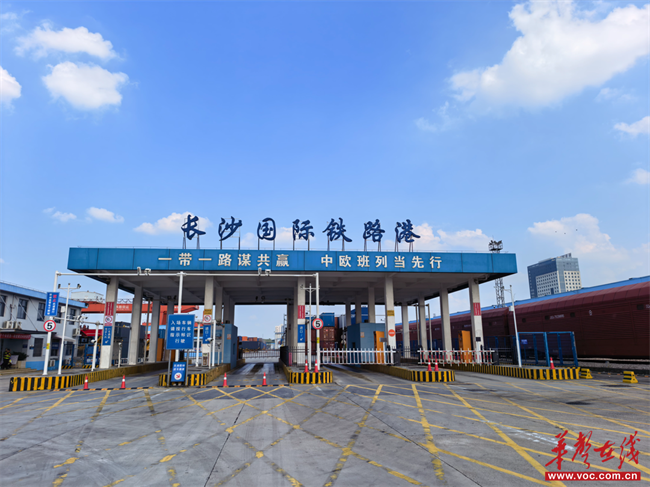
Located within the Jinxia Economic Development Zone, Changsha International Railway Port serves as a stop along the silk road on steel rail connecting Changsha to the Eurasian continent. (Photo/Zou Weiyu)
Walking through the railway port, you can see the steel rails are crisscrossed in all directions, extending far and wide. Heading north, the tracks connect directly to the four major border ports of Manzhouli, Erenhot, Alashankou, and Khorgos. To the west, the routes link into the New International Land-Sea Trade Corridor. This freight train transportation network extends to more than 30 countries, covering 100 cities abroad.
Inside the port area, trucks move back and forth without pause. On ordinary days, two China-Europe freight trains depart punctually each day. During peak freight seasons, three to four trains depart in succession, with whistles rising one after another. The robust operational scale has kept Changsha's China-Europe Railway Express service firmly in the national top tier for seven consecutive years.
In 2025, a total of 589 China-Europe freight trains were operated throughout the year in Changsha, with a cargo value exceeding 2.3 billion USD. In the first five months of 2026, a cumulative total of 297 China-Europe freight trains were dispatched here, with a cargo value of 1.172 billion USD, representing a 56.3% year-on-year surge in train operations. The relentless roar of the rails reflects a bustling and dynamic logistics landscape.
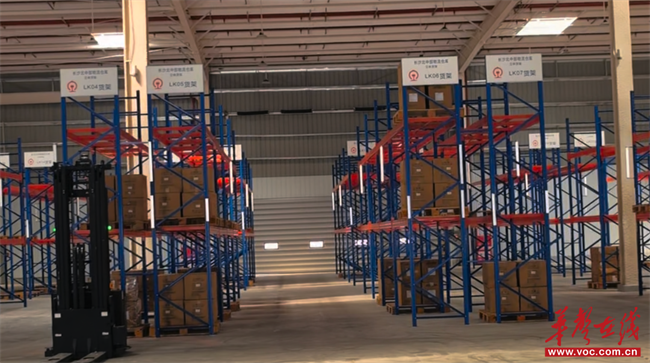
A high-standard intelligent warehouse offers a spacious and clean storage environment. (Photo/Zou Weiyu)
A high-standard intelligent warehouse offers a spacious and clean storage environment. The spacious 10.4-meter-high facility is open and well-ventilated, and the wear-resistant flooring is spotlessly clean, completely reversing the dusty working conditions typical of old warehouses. Several automated guided vehicles (AGVs) flash green lights as they shuttle orderly, smoothly delivering packaged automotive parts. Relying on laser obstacle avoidance system, the AGVs navigate flexibly through storage aisles and arrive precisely at the security inspection zone. Nearby, 3D volume measurement equipment automatically scans and collects cargo box specifications, while staff complete data entry by scanning codes with handheld terminals. Cargo information is instantly synchronized to the system, enabling unmanned operations throughout cargo transfer and warehousing inspections. After completing customs inspection, this batch of precision automotive parts will depart westward on a China-Europe freight train bound for multiple European countries.
"In recent years, the operational scale of the freight train service has continued to expand, and the categories of export goods have been constantly upgraded. The old warehousing facilities could no longer match business development needs," Deng Feng, manager of the Station Business Department at Changsha Railway Logistics Center, explained to the reporter. Over the past decade, export cargo sources have undergone iterative upgrading. In the early years, goods were mostly porcelain and small daily-use commodities, whereas now high-value-added products like engineering machinery and automotive components have become the mainstay.
This state-of-the-art warehouse adjacent to the customs-supervised area allows goods to go directly to inspection points after leaving storage. Combined with electric loading/unloading ramps, cargo handling efficiency has been greatly enhanced. Currently, the warehouse has attracted foreign trade enterprises in automotive parts, electronics, and home appliances to settle down, providing integrated full-chain services encompassing warehousing, trunk transportation, and goods distribution. Accordingly, Changsha North Logistics Park has transformed from a single-point cargo transit node into a comprehensive cross-border supply chain distribution center.
Not far away, the 92 mu (6.15 ha.) dedicated customs supervision zone buzzes with similar activity. Over a thousand standard containers are neatly stacked, with inspection, quarantine, and fumigation operations integrated in one zone. Yu Wenliang, head of the Second Comprehensive Business Section of the Xingsha Customs Authority, guided the reporter toward the H986 large-scale inspection equipment. The device performs comprehensive container scans, completing inspections without opening boxes. The park innovates with an "inspect-before-loading" model, complemented by the 95306 digital port system and "railway express clearance" service. Declaration and inspection processes that once took half a day can now be completed within half an hour, with clearance for simple goods taking just minutes. With customs supporting round-the-clock appointment clearance, tax incentives for return-trip freight trains alone saved enterprises over nine million CNY in taxes in 2025.
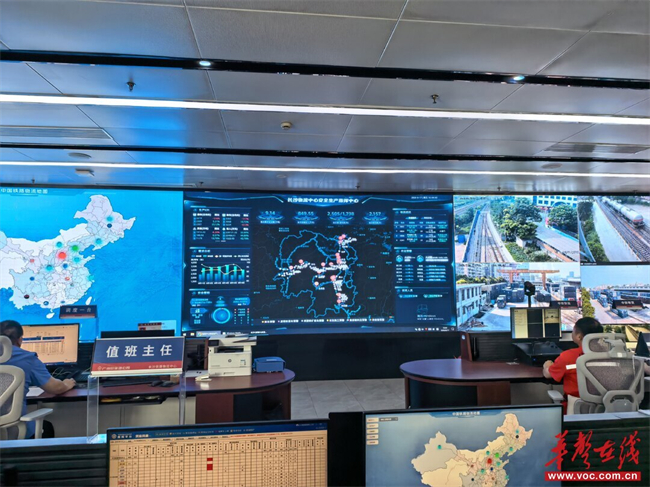
The Safety Production Dispatch Center serves as the "intelligent hub" of the entire route. (Photo/Zou Weiyu)
The Safety Production Dispatch Center in the port area acts as the "intelligent hub" for the whole route. A gigantic screen scrolls real-time dynamic data on vehicle flows, cargo flows, and customs clearance status. Staff members coordinate end-to-end connections during two daily shift-based dispatch meetings. As a pilot site for national digitalized and intelligent stations, after full equipment digital transformation, online processing of dispatch procedures has been compressed from two hours to just ten minutes, dramatically boosting efficiency.
Su Ming, manager of the Changsha Business Department of China Railway Container Transport (CRCT), pointing to the two-way flow of trains, explained that the park has tailored freight solutions to local industries. Aligned with equipment enterprises such as SANY, Zoomlion, and Sunward Intelligent, it has operated over a thousand customized engineering machinery trains over the decade, with 138 trains already operated in the first five months of this year alone. For small and medium-sized traders, a "Silk Road LCL" service was introduced. The Changsha-Poznan fixed schedule train launched at the end of 2025 has since operated 29 trains on its punctual weekly departures. Over the decade, cumulative return-trip trains reached 1,884, steadily arriving loaded with European timber and agricultural products. This has completely resolved the earlier predicament of "many exports, empty returns," achieving balanced two-way circulation.
The port has been upgraded from the rudimentary, dust-covered stacking yards of early years to today's modern warehouses with robotic operations, and from laborious, time-consuming manual inspections piece by piece in the past to effortless, fast online customs clearance today. Over the past decade, this freight train route running between Europe and Asia has tangibly helped local Hunan enterprises open up overseas sales channels, while also bringing high-quality foreign goods into the domestic market. It has been increasingly widening the path for inland cities to embrace opening-up, continuously contributing Changsha's efforts to the Belt and Road Initiative.
This article is from Hunan Provincial Government. www.enghunan.gov.cn.
Translator: Yu Jiangjiang
Chinese source: Voice of Hunan



 Hunan PSB Cyber Security Filing: No. 43010302000524