


On the afternoon of April 24, Mao Weiming, deputy secretary of the CPC Hunan Provincial Committee and governor of the People's Government of Hunan Province, met in Changsha with a delegation led by Hans Albrecht, chairperson of the Board of Global Bridges, and Wu Ken, president of the Chinese People's Institute of Foreign Affairs. The guests came to Changsha to attend the 11th China-Germany Young Leaders Conference.
Also present were Yu Hongsheng, vice governor of the People's Government of Hunan Province, and Wang Wei'an, secretary general of the People's Government of Hunan Province.
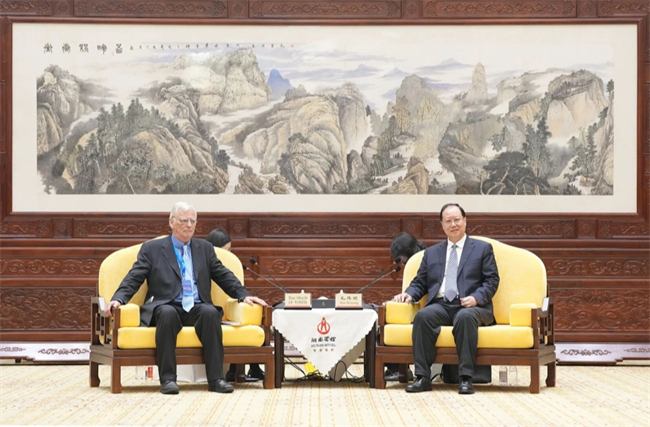
Governor Mao Weiming holds talks with Chairperson Hans Albrecht.
The China-Germany Young Leaders Conference was jointly established by the Chinese People's Institute of Foreign Affairs and the Global Bridges. The conference is held annually, with China and Germany as alternating hosts. The conference serves as a key mechanism for youth exchange and cultural collaboration between China and Germany. The event aims to foster in-depth interaction among young people from both countries, thereby laying a solid foundation of public support for the long-term sound development of Sino-German relations and cultivating important forces for cooperation.
The 11th China-Germany Young Leaders Conference was held in Hunan between April 22 and 26. During the event, participants visited relevant companies and engaged in dialogue with local young people on innovation and entrepreneurship, to gain a deeper understanding of Hunan's economic and social development.
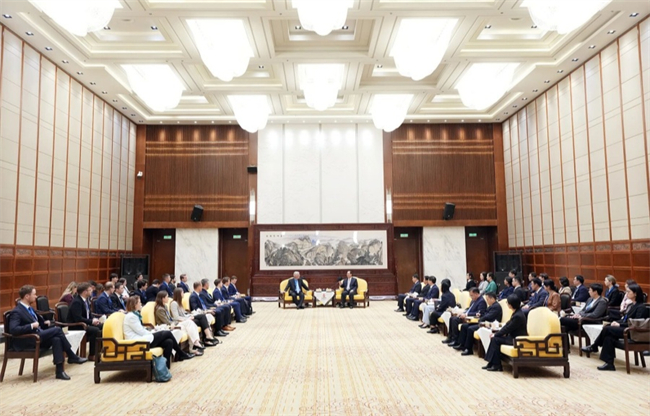
The meeting.
Currently, 38 German-funded enterprises, including Volkswagen, Bosch, and BASF, have established branches in Hunan, while Hunan-based companies such as Zoomlion, Sany Heavy Industry, and CRRC Zhuzhou Locomotive have invested and expanded business in Germany. Hunan has established the "German SME Headquarters Cluster (Hunan)," successfully attracting a number of German companies to set up their headquarters here. In the first quarter of this year, Hunan's total imports and exports with Germany increased by 54.8% over the previous year.
Governor Mao expressed his hope that the Global Bridges and the Chinese People's Institute of Foreign Affairs would fully leverage their platforms, talent, and resources to help Hunan and Germany further deepen economic and trade cooperation, strengthen collaboration in science and technology innovation, and expand people-to-people exchanges, thereby achieving mutual benefit and win-win outcomes.
Chairman Hans Albrecht noted that China's development achievements have attracted global attention. In particular, what they have seen and experienced in Hunan has given them a deep sense that China's embrace of AI and technology demonstrates the direction of future development to the world. The Global Bridges will remain committed to promoting dialogue and exchange between Germany and China. Hans Albrecht added that taking this visit to Hunan as an opportunity, the program will continue to further enhance mutual understanding and trust between the people of both regions, especially among young people. Through mutual learning and exchange, the two sides will strengthen cooperation, foster friendship, and build consensus for joint action.
Photos taken by Liu Shangwen.
This article is from Hunan Provincial Government. www.enghunan.gov.cn.
Translator: Xiao Juan
Chinese source: hunan.gov.cn




 Hunan PSB Cyber Security Filing: No. 43010302000524