

Home>Tourism>Statistics
Zhangjiajie Sees 24.7% Growth in Inbound Ticket Buyers
The magnificent Zhangjiajie National Forest Park is becoming an increasingly prominent landmark on the world tourism map.
From January to October 2025, the park welcomed 1.1298 million inbound visitors, of whom 820,100 purchased tickets, marking a year-on-year increase of 24.70%, with tourists coming from 179 countries and regions worldwide.
Against the backdrop of total visitor numbers remaining largely flat compared to the peak historical year, the robust growth of inbound tourism is like a surge breaking across a tranquil lake, standing out as a brilliant highlight.
Breaking Down Barriers — From Language to Payments
"In the past, when I saw foreign visitors, I wanted to help but dared not speak for fear of making mistakes," admitted Zhang Jufang, a staff member at the ticket office of Zhangjiajie National Forest Park.
This sense of helplessness was once a weak spot in the park's international service capabilities.
Today, standing at the ticket window, she can fluently guide visitors through the ticket purchasing process in English. This transformation began with a language initiative called the "Golden Whip Stream Night School."

A staff member explains to foreign visitors.
In July this year, the park hired foreign language instructors from Jishou University to provide intensive English and Korean trainings for frontline staff. The classes were held by the banks of Golden Whip Stream after visitors had left for the day, helping employees evolve from "daring not to speak for fear of mistakes" to "daring to speak and good at guiding."
"What we learned wasn't just vocabulary—it was the courage to break down cultural barriers," remarked one environmentally friendly shuttle bus driver who participated in the training.
At the same time, a comprehensive multilingual signage system in Chinese, English, and Korean was quietly rolled out across the entire scenic area.
From maps and directional signs to safety warnings and cultural explanations, even visitors who do not understand Chinese can easily "decode" the bizarre peaks. A French tourist shared on social media, "I was amazed by how clear the signage is here. I even learned the love story behind the 'Couple Rocks' through the signs."
Once the language barrier was removed, the payment problem followed suit.
At core attractions such as the Bailong Elevator and Tianzi Mountain Cableway, the signage at payment windows has quietly evolved: alongside cash, Alipay, WeChat, and UnionPay, international credit card logos such as VISA and Mastercard now stand prominently. The park fully supports linking overseas bank cards to mobile payment systems, allowing overseas visitors to enjoy the same payment convenience as Chinese tourists.
"This solved our biggest headache," said a backpacker from Italy. "I don't need to exchange a lot of cash in advance. I can just scan QR codes like the locals to take the cable car or buy souvenirs — it feels great."
Behind this lies Zhangjiajie's systematic efforts as one of the first pilot cities in China to optimize payment services, marking a genuine upgrade from "getting by" to "having a great time."
Experience Innovation — Warmth and Stories Amid the Mountains
Beyond the unparalleled natural beauty, what else captures the hearts of visitors? Zhangjiajie's answer is warm, heartfelt service and tangible culture.
"The staff here seem to be able to 'transform'!" a South Korean tourist shared on social media, recounting his amazement: the guide who enthusiastically introduced him to Tujia legends had just turned around and deftly picked up a piece of litter on the road, then within minutes provided initial assistance to a visitor who was feeling unwell.
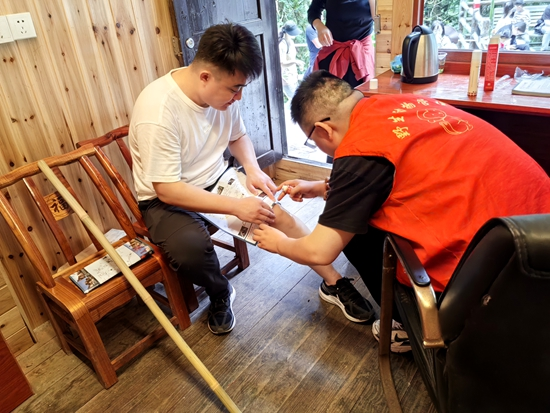
A staff member tends to an injured visitor.
This is precisely the park's innovative "Five Roles in One" service model — where every staff member serves as a cleaner, guide, promoter, safety officer, and first one to respond all at once.
At Golden Whip Stream, the job of a cleaner surnamed Li is no longer limited to sweeping. He carries a small megaphone and uses self-taught foreign phrases to greet passing international tourists while keeping a constant eye on their safety.
"I'm now the 'steward' of this scenic area," he said with a smile. "My job is to keep it clean and also to make sure visitors feel safe."

A staff member answers questions from foreign visitors.
The warmth of service is also evident in the smallest details.
During the 2025 National Day holiday, on a morning when temperatures dropped sharply, the park offered a "Cup of Ginger Tea to Warm the Heart" service at its main entrances to waiting visitors.
Staff members handed directly steaming cups of ginger tea to visitors from around the world, instantly dispeling the mountain chill.
A Malaysian tourist remarked, "This cup of tea warms the hands, but even more, it warms the heart. Zhangjiajie's mountains and waters may be cold, but the warmth of the people here is truly heartwarming."

A staff member delivers a cup of ginger tea to a visitor.
Culture, meanwhile, gives soul to the natural scenery.
During holidays this year, Zhangjiajie transformed into a grand garden of intangible cultural heritage, with the bold Baishou dance and the lively bamboo pole dance of the Tujia people, and the melodious Huadeng opera unfolding in turns among the clouds and peaks.
At the Huangshizhai Sqaure, Mark from the United States, invited by an inheritor of intangible cultural heritage, excitedly joined the Baishou dance. "This is so cool!" he exclaimed. "I came just to see the mountains, and unexpectedly became part of their culture."
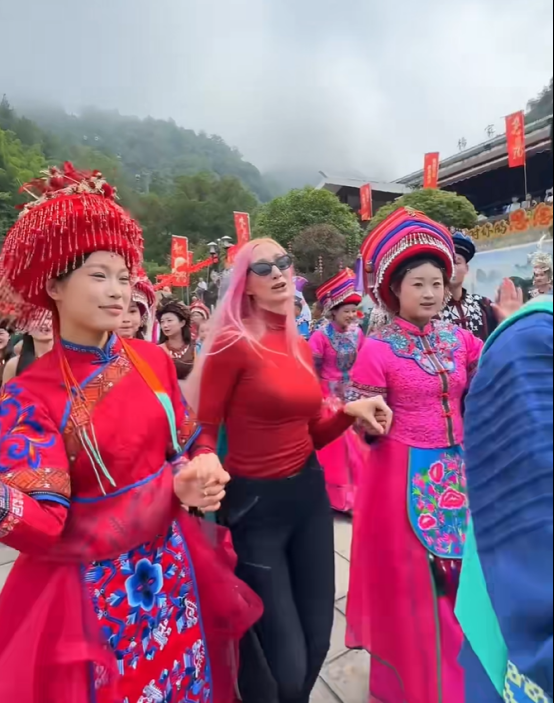
A foreign visitor participates in an intangible cultural heritage performance.
These activities are far from mere assemblages.
Through thoughtful design, the park has transformed intangible cultural heritage from static "exhibits" into "travel stories" that visitors can participate in and remember, sparking a wonderful synergy between the beauty of nature and the charm of humanity.
Smart Marketing — The "Zhangjiajie Impression" Goes Global
In September 2025, a short video titled "Foreigners Doing the 'Zombie Dance' in Zhangjiajie" quietly went viral across the internet.
This seemingly casual selfie-style video by tourists garnered over 10 million cumulative views across WeChat Channels, Douyin, Xiaohongshu, and other platforms, becoming an unexpected viral hit for the scenic area.
In the video, several young foreigners on the Yuanjiajie obsevation platform mimic classic "zombie" moves, against a backdrop of mist-shrouded, rugged stone peaks. This collision and contrast of cultures produced a wonderfully captivating effect.
The park has also been leveraging the global influence of the "Avatar" film franchise, precisely positioning itself as the "prototype location for the floating mountains." The park also closely links the film's fantastical scenes with the real-life peaks of Zhangjiajie, drawing fans from around the world to "take photos" and experience the connection for themselves, further boosting its international reputation.
Yet this is just the tip of the iceberg of Zhangjiajie's smart marketing strategy.
The park systematically organized a large-scale live-streaming event called "A Thousand Livestreamers Promote Three Thousand Bizarre Peaks." The campaign broadcasted Zhangjiajie's landscapes and extreme sports events across domestic and international platforms such as Douyin, TikTok, and Instagram through the lenses of livestreaming influencers, forming a formidable new media communication matrix.
Even more impactful content comes from the extreme sports arena.
The extreme bungee swing beside the Bailong Elevator and the high-altitude slackline competition atop Huangshizhai — these visually stunning international events not only attract the world's top athletes but also generate sustained global communication hot spots. As athletes walk and leap among the hundreds-of-meters-high peak forests, Zhangjiajie's image is inextricably linked with words like "courageous,""challenging," and "extraordinary," etching itself deeply into the hearts and minds of audiences worldwide.
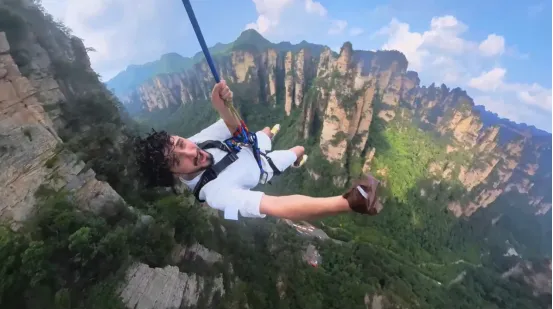
A foreign visitor experiences bungee among the peaks.
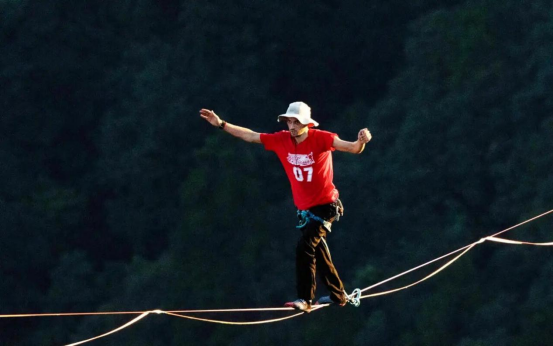
A competitor on the slackline.
Faced with this impressive results, the Administration of Zhangjiajie Wulingyuan Scenic Area and National Forest Park believes that the Implementation Plan for Tourism Development Incentives of Zhangjiajie City 2025 and the "240-hour visa-free transit" policy have provided crucial support for the recovery of inbound tourism. "However, to transform policy dividends into sustained momentum, the key lies in strengthening our 'internal capabilities'."
Chinese source: Hunan Provincial Department of Culture and Tourism

 Hunan PSB Cyber Security Filing: No. 43010302000524