


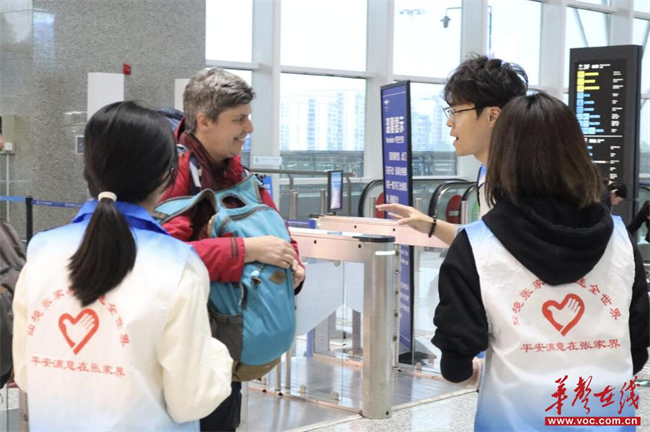
Volunteers assist a foreign traveler at the airport. (Photo provided by correspondents)
Walking Tour Guides in the Terminal
"We traveled in China for 15 days and felt the kindness of the Chinese people everywhere. You are so considerate," a Brazilian traveler repeatedly expressed his gratitude to volunteer Li Shaohan in the lounge of Zhangjiajie Hehua International Airport on July 24.
As China's inbound tourism market continues to heat up, more and more overseas travelers are arriving in Zhangjiajie by air. However, language barriers and the absence of cultural interpretation often pose challenges. In 2025, to tackle the challenges of improving international services and boosting the city's global profile, under the guidance of the CYL Zhangjiajie Municipal Committee, Zhangjiajie Hehua International Airport pooled foreign-language talent from local universities and launched the youth interpreter volunteer team, to facilitate communication for inbound travelers.
"We traveled in China for 15 days and felt the kindness of the Chinese people everywhere. You are so considerate," a Brazilian traveler repeatedly expressed his gratitude to volunteer Li Shaohan in the lounge of Zhangjiajie Hehua International Airport on July 24.
As China's inbound tourism market continues to heat up, more and more overseas travelers are arriving in Zhangjiajie by air. However, language barriers and the absence of cultural interpretation often pose challenges. In 2025, to tackle the challenges of improving international services and boosting the city's global profile, under the guidance of the CYL Zhangjiajie Municipal Committee, Zhangjiajie Hehua International Airport pooled foreign-language talent from local universities and launched the youth interpreter volunteer team, to facilitate communication for inbound travelers.
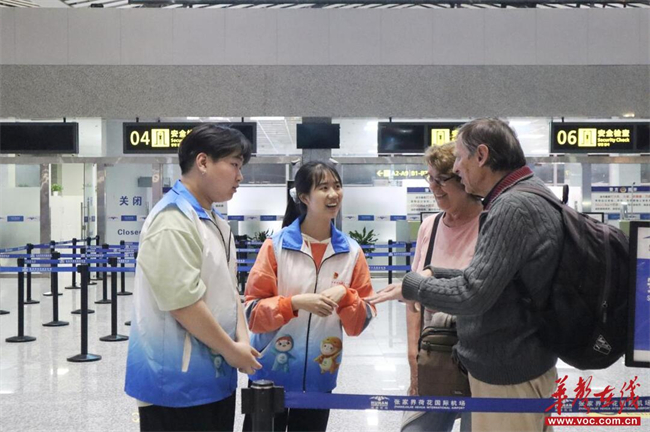
Most youth interpreter volunteers are students from local universities in Zhangjiajie. (Photo provided by correspondents)
Li Shaohan is a junior student majoring in English at the School of Literature, Zhangjiajie College. Since joining the volunteer team in 2025, she has logged over 200 volunteer hours at the airport, assisting travelers from around the world.
"As English majors, we need practice in diverse scenarios, and the airport is an ideal 'internship base.'" Besides daily consultation services, the interpreter volunteers also undertake the city's cultural tourism promotion tasks, Li said. They use their language advantages to share folk customs with guests from afar. "We are not just interpreting. We are a bridge between cultures," she said.
Organized and mobilized by the CYL Zhangjiajie Municipal Committee, an over-800-person youth interpreter volunteer team has been formed, with 10 volunteers on duty daily. Made up of foreign language majors and foreign teachers from local universities, the volunteers are well-versed in airport operations and local tourism policies, supporting check-in counters, information desks, and international flight services. During travel rush periods — summer vacations, and Spring Festival, May Day, and National Day holidays — they are key to keeping airport services running smoothly.
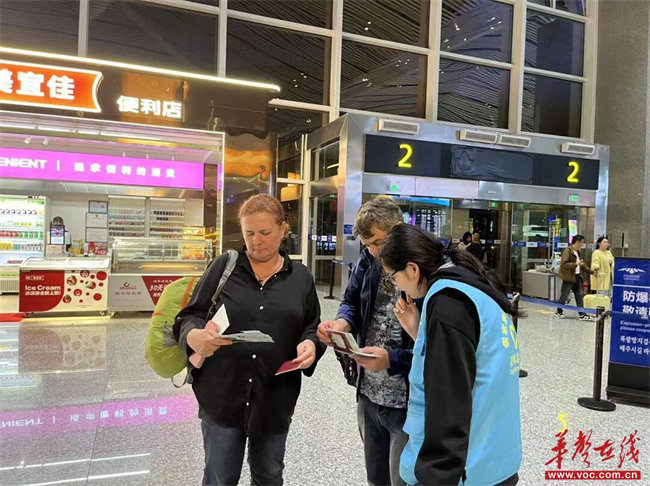
The interpreter volunteer service team currently has over 800 members. (Photo provided by correspondents)
"Volunteer services have significantly boosted the airport's service quality and cultural atmosphere, making them an integral part of our aviation-culture-tourism offering," said Zhou Fengzhen, secretary of the CYL Zhangjiajie Airport Committee. Since the volunteer service program was launched more than a year ago, volunteers have provided over 12,000 hours of service and addressed nearly 2,000 issues from foreign travelers. Beyond providing a practice platform for the students, the program has blazed a new trail in integrating cultural tourism with volunteer service.
"Performing While Interpreting" Pioneers Aviation Tourism Promotion
During the May Day holiday, Zhangjiajie Hehua Airport became an unexpected stage for intangible cultural heritage. Powerful yet graceful Tujia Hand-waving Dance, the rhythmic beats of the Three-Stick Drum, and melodious tunes of Daliuzi, took the stage in succession.
"Performing While Interpreting" Pioneers Aviation Tourism Promotion
During the May Day holiday, Zhangjiajie Hehua Airport became an unexpected stage for intangible cultural heritage. Powerful yet graceful Tujia Hand-waving Dance, the rhythmic beats of the Three-Stick Drum, and melodious tunes of Daliuzi, took the stage in succession.
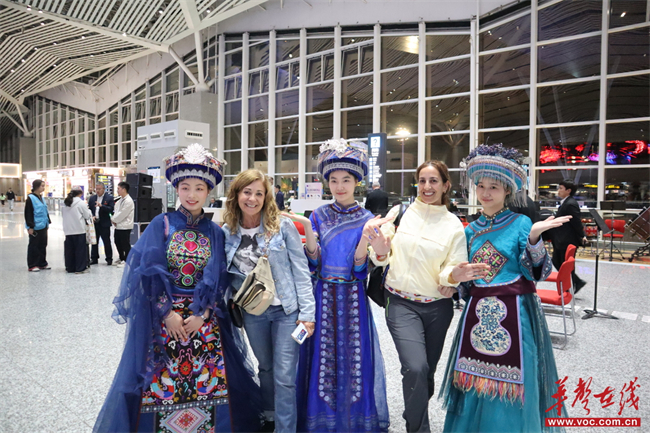
Volunteers in ethnic costumes pose for a photo with foreign travelers. (Photo provided by correspondents)
At a live show, the jingling of Tujia girls' silver ornaments mingled with real-time interpretations by volunteers. "This is the traditional Tujia Hand-waving Dance. The movements imitate farming activities such as transplanting rice seedlings and harvesting, embodying wishes for a bumper harvest..."
In the past, Zhangjiajie airport mainly conducted cultural tourism promotion via display boards and paper leaflets — a monotonous approach with limited interactivity, rarely leaving a lasting impression on travelers. This year, the airport has leveraged the youth interpreter volunteers as a key driver, innovating promotional means and expanding publicity channels, to create an immersive, real-life experience that weaves cultural tourism into every step of the passenger's waiting journey.
The volunteers perform and interpret simultaneously, while travelers watch and listen. Here, the language and cultural barriers are broken, transforming the intangible cultural heritage showcases into a cultural experience that is both accessible and emotionally resonant. "Every movement tells a story—such interpretation gives me a deeper understanding of Chinese culture and its ethnic traditions," said an American traveler.
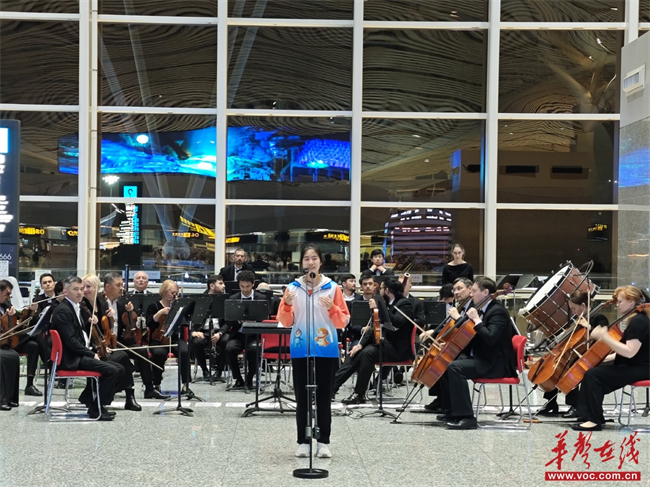
A volunteer provides multilingual introductions during an orchestra performance. (Photo provided by correspondents)
In addition to intangible cultural heritage showcases, the airport has teamed up with the Zhangjiajie Philharmonic Orchestra to stage regular performances in the terminal. The repertoire spans world classics, ethnic music, and Zhangjiajie-style shows. The interpreter volunteers provide multilingual interpretation simultaneously, sharing the stories behind the folk music. The melodious music, paired with breathtaking natural landscapes displayed on large screens in the departure lounge, drew many travelers. These scenes quickly went viral across platforms like WeChat Moments and Douyin, attracting numerous fans from around the world.
With the summer travel rush now in full swing, the number of travelers from Central Asia has grown significantly. To bridge the gap in services in less commonly spoken languages, the CYL Zhangjiajie Airport Committee launched a targeted initiative to bring Uyghur students from local universities into the interpreter volunteer team.
"Uyghur has many similarities with Central Asian languages, making it convenient for us to communicate." Ayi, from Hotan, Xinjiang, is a first-year student majoring in drones from Zhangjiajie Institute of Aeronautical Engineering and one of five Uyghur members on the volunteer service team. Their participation not only helps Central Asian travelers address communication problems, but also serves as a vivid testament to ethnic unity and progress in Zhangjiajie.

A volunteer in ethnic costumes gives multilingual explanations. (Photo provided by correspondents)
Outside the terminal of Zhangjiajie Hehua International Airport, soaring planes carry thousands of passengers arriving or departing, while inside, volunteers in blue vests use language as a bond and service as a medium to convey Zhangjiajie's magnificent mountains, rivers, and ethnic customs to every traveler from around the world.
Moving forward, Zhangjiajie Airport will further enhance the brand of youth interpreter volunteer service and the image of airport-based cultural tourism, Zhou said. The touching stories of this world-class tourist city will be conveyed to every corner around the world through this airport.
This article is from Hunan Provincial Government. www.enghunan.gov.cn.
Translator: Pang Yuehui
Chinese source: Voice of Hunan




 Hunan PSB Cyber Security Filing: No. 43010302000524