


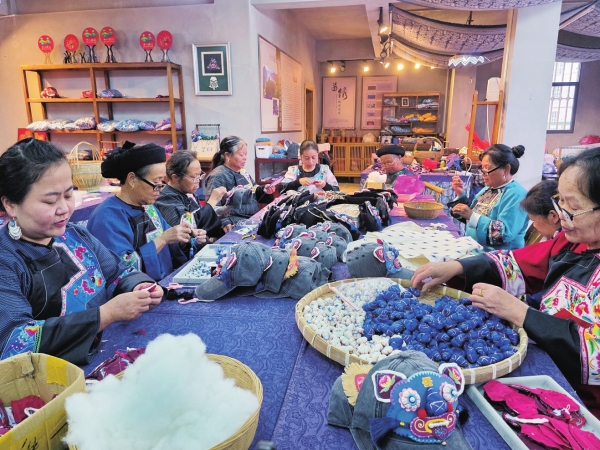
On May 15, embroiderers are busy making tiger-head hats at the Shibadong Miao Embroidery Rural Revitalization Demonstration Base. (Photo/Wu Manjin)
Recently, a delightful encounter between Eastern and Western cultures at the Great Hall of the People in Beijing swept across global social networks. The son of Tesla CEO Elon Musk, wearing a new Chinese-style mulberry silk vest and a lively tiger-head hat, quickly ignited an online frenzy to find the same style.
This tiger-head hat was crafted in Shibadong Village in Hunan's Xiangxi Tujia and Miao Autonomous Prefecture—the birthplace of China's "targeted poverty alleviation." Once again the world was astonished with Miao embroidery intangible cultural heritage hidden deep in the Wuling Mountains.
A Tiger-Head Hat Ignites the Internet, Miao Village's Intangible Cultural Heritage Amazes the World
Amid the buzz, orders flooded in like a tide. A massive influx of orders poured into the Shibadong Miao Embroidery Rural Revitalization Demonstration Base. Manager Wu Manjin couldn't hide her delight, "We received 1,000 orders in a single day back then, and the total order volume has now exceeded 10,000, with the production scheduled for one month later!"
The tiger-head hat that has gone viral is a specialty product jointly created by Shibadong Miao embroidery producer and the Beijing Eve Group, sold at Eve Group's physical store in the Chang'an Market in Beijing. While a constant stream of customers flocked into the online store, orders at the physical store have also surged simultaneously. Derivative products in the tiger-head element series, such as bucket bags and frame purses, have also ignited a sales boom, with orders exploding across the entire product line.
In the intelligent automated Miao embroidery production workshop, six-colored threads, precisely guided by robotic arms, shuttle and intertwine lightly. A tiger-head outline and simple patterns take shape on the embroidery cloth. In the base adjacent to the workshop, embroiderers sit in a circle. Their fingertips danced, creating various delicate components like tiger ears, tongues, and eyes vividly.
"The tiger's eyes need more depth to bring out their spirit."
"The tassel whiskers must be neat, or even a slight tilt will rob them of their spirit."
The embroiderers bustled, sharing their views on embroidery skills.
This tiger head hat is half embroidered and half handcrafted into a three-dimensional form. It feels plump and full to the touch, as if imbuing the tiger head with life—seemingly angry yet adorable. The tassel whiskers quiver with a gentle shake, making the tiger even more jaunty. The most profound meaning lies in a ring of fine "dog-tooth stitches" along the hat's edge—a classic pattern in Xiangxi's Miao embroidery which has been passed down for over a thousand years. In the Miao culture, dog teeth can ward off evil spirits. This ring of plain stitches carries a mother's deepest prayers for her child: peace, health, and immunity from all illnesses.
The tiger-head hat's viral success may seem accidental. Actually, it is an explosive payoff of over a decade of painstaking work by Shibadong Miao embroiderers.
In 2014, 54 embroiderers established a Miao embroidery cooperative guided by the village Party committee, allowing the craft of fingertips to dip into the market for the first time. In 2022, the Miao Embroidery Cultural Industry Co., Ltd. was founded, forming a "cultural inheritance + industrial development" model. In 2023, empowered by the Rural Revitalization Plan for Shibadong Area, the small workshop transformed into a complete industrial chain integrating production, display, and study tour.
"We once had to go everywhere seeking orders and sales channels. Today, orders are lining up to us. We have the confidence and assurance to make Miao embroidery even better!" The embroiderers' smiles were filled with pride and anticipation.
A Viral Hit Created by a Xiangxi Vocational College Student
This viral hit tiger-head hat is an original creation by Li Wen, a "post-2000s" designer at the Shibadong Miao Embroidery Industry College of the Xiangxi Vocational and Technical College for Nationalities. Her design infused new life into the thousand-year-old intangible cultural heritage with youthful creativity.
Li Wen was born in Luxi County, Xiangxi in 2003. In her youth, she often stayed by her mother's side, quietly watching her embroidering shoe uppers and knitting sweaters skillfully. Patterns of lotus flowers, swimming fish, and dancing birds were woven into her memory.
In 2021, Li Wen was admitted to the Xiangxi Vocational and Technical College for Nationalities. Without hesitation, she chose to major in Arts and Crafts Design, systematically studying Miao embroidery stitches and design, thereby embarking on her path of intangible cultural heritage inheritance and creation.
"The classic patterns and shapes touched me." Li Wen's inspiration came from an old Miao tiger-head hat embroidery piece she happened to see online in early 2025. Its vintage charm struck her deeply, sparking her design idea for a re-creation. She hoped to preserve the essence of the intangible cultural heritage while aligning with modern aesthetics, to revitalize the traditional old style with new life and vitality.
The first version of the tiger-head hat was produced in February 2025, but Li Wen was not satisfied. She and her mentor Huang Juan repeatedly deliberated and continuously optimized details of design, incorporating the cloth art from Shaanxi and Gansu areas into her work.
In terms of stitches, Li Wen adopted the distinctive "dog-tooth stitch" in Xiangxi to outline the tiger's face, and embroidered a pomegranate pattern on each of the two ear flaps of the hat, conveying auspicious wishes for abundant offspring and good fortune.
After three months of repeated refinement, the tiger-head hat's design broke away from the traditional solemn stereotype, becoming lively and cute with its tongue stuck out. Furthermore, the tiger's teeth were made of six pearls strung into a line, the tongue was embellished with a lotus pattern, and the overall blue-purple color scheme was visually appealing and practical due to its dirt resistance.
Today, as a study tour instructor in Shibadong Village, Li Wen often tells students the stories of Miao embroidery patterns. She always remembers her mentor's teaching: "Only by probing into local ethnic culture can you create intangible cultural heritage works with warmth and cultural value."
Besides the tiger-head hat, she also drew inspiration from the 512-million-year-old Huayuan Biota to create a "Fish Frolic" bag series, which embodies both the liveliness of "fish playing amidst lotus leaves" and the blessing of "prosperity year after year." This series combines ancient creatures with Miao embroidery skills, making each piece a cultural sign traversing time, and bringing intangible cultural heritage to life with the strength of young people..
University-Local Government Collaboration Empowers Production of Viral Hits
Behind the global popularity of the tiger-head hat lies the strong support from the deep collaboration between Shibadong's Miao embroidery cultural industry and the Xiangxi Vocational and Technical College for Nationalities. The "industry-university-research-application" integrated model helps traditional intangible cultural heritage ignite a globally fashionable Chinese trend.
The Xiangxi Vocational and Technical College for Nationalities gathers numerous representative inheritors of intangible cultural heritage and excellent teachers engaged in intangible cultural heritage teaching, such as Ye Shuiyun, national-level representative inheritor of the Tujia brocade weaving technique; Peng Xiaojun, prefecture-level representative inheritor of Xiangxi Miao embroidery; and, Huang Juan, long dedicated to inheriting and teaching Miao intangible cultural heritage skills. These artisans and professional teachers join hands in teaching, connecting the entire chain of skill inheritance, product research and development, and practical marketing. Many students take root in Shibadong Village for practical training, learning traditional skills, modern design, and market-oriented operations in an immersive way, letting youthful creativity deeply collide with intangible cultural heritage.
"The college has established a professional design team focusing on product R&D and creative design, ensuring Miao embroidery aligns with modern aesthetics and meets market demands," said Yang Meikai, spokesperson from the Miao Embroidery Industry College at the Xiangxi Vocational and Technical College for Nationalities. Today's Miao embroidery products have broken through the boundaries of traditional clothing. They integrate intangible cultural heritage elements into daily items like brooches, hairpins, round fans, handbags, and cultural creative dolls, forming a rich and diverse product catalogue. Boasting impressive innovation strength, Shibadong Village's Miao embroidery has already obtained over 500 design patents and copyrights, using intellectual property to safeguard the industrialization of intangible cultural heritage.
Relying on its superior quality and cultural heritage, Shibadong Village's Miao embroidery has been displayed in many authoritative cultural venues like the China Intangible Cultural Heritage Museum, Rong Bao Zhai, and the Palace Museum. The mugwort hammer co-designed with the Palace Museum design team, and the "Flowers Bloom in Shibadong" series, which won the Gold Award in the Hunan Provincial Cultural Tourism Commodity Competition, were selected as state gifts at the Shanghai Cooperation Organization Summit, presenting the beauty of Chinese intangible cultural heritage to the world. In 2025, over 200,000 Miao embroidery products stepped out of Xiangxi, spreading across the country and advancing towards the world.
This article is from Hunan Provincial Government. www.enghunan.gov.cn.
Translator: Pang Yuehui
Chinese source: Chinanews



 Hunan PSB Cyber Security Filing: No. 43010302000524