


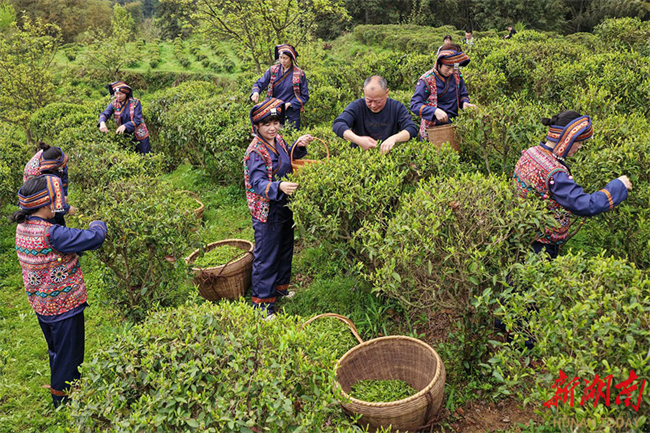
The photo, taken on April 10, shows tea farmers picking wild tea buds at the Shunhuangshan National Nature Reserve in Hunan Province. The wild tea plants grow in a pristine ecological zone on Shunhuang Mountain, at altitudes ranging from 600 to 1,800 meters. This zone is the largest and best-preserved germplasm resource bank of wild tea plants in the province. In recent years, the local authority has focused on both protection and development, striving to transform ecological advantages into industrial strengths. Through standardized harvesting and brand building, more than 3,000 farmer households have seen their incomes rise, with an average annual increase of over 8,000 CNY per household. A new path that harmonizes ecological conservation with rural revitalization has taken shape. (Photo/Yan Yuebin and Zhu Jubin)
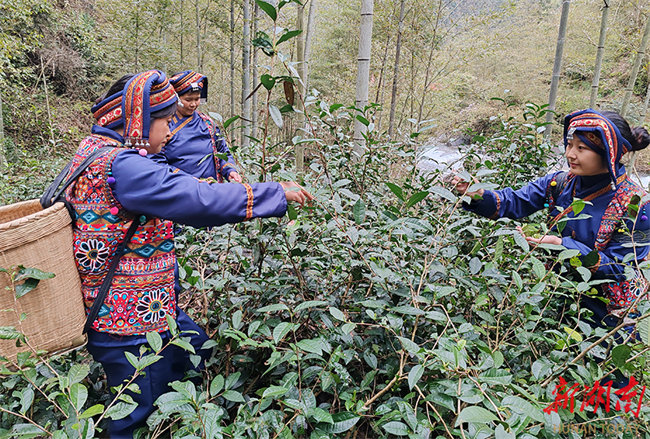
The photo, taken on April 10, shows tea farmers picking wild tea buds at the Shunhuangshan National Nature Reserve in Hunan Province. The wild tea plants grow in a pristine ecological zone on Shunhuang Mountain, at altitudes ranging from 600 to 1,800 meters. This zone is the largest and best-preserved germplasm resource bank of wild tea plants in the province. In recent years, the local authority has focused on both protection and development, striving to transform ecological advantages into industrial strengths. Through standardized harvesting and brand building, more than 3,000 farmer households have seen their incomes rise, with an average annual increase of over 8,000 CNY per household. A new path that harmonizes ecological conservation with rural revitalization has taken shape. (Photo/Yan Yuebin and Zhu Jubin)
This article is from Hunan Provincial Government. www.enghunan.gov.cn.
Translator: Pang Yuehui
Chinese sources: hunan.gov.cn; hunantoday


