


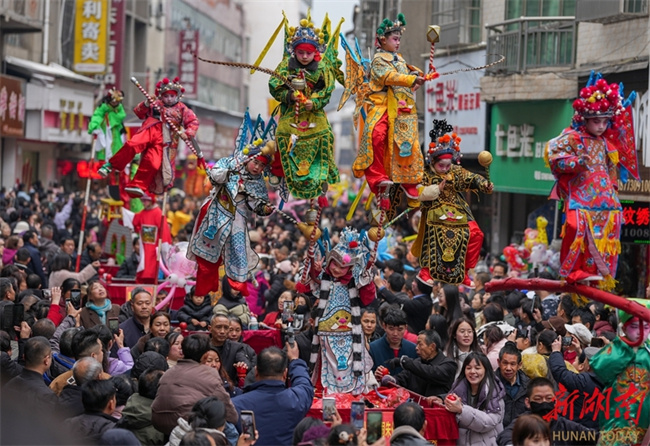
On March 2, a Changle Taige performance was staged in Changle Town, Miluo City, attracting crowds of tourists. The Changle Taige performance is a thousand-year-old folk tradition originating from the Sui and Tang dynasties (581-907) and thriving during the Ming and Qing dynasties (1368-1911). This art form evolved from ancient sacrificial rites and Lantern Festival celebrations held in the first month of the Chinese lunar calendar in ancient times, blending acrobatics, painting, opera, and folk customs. In 2011, the Changle Taige performance was included in the extended list of national intangible cultural heritage. (Photo/Song Zhengjun)
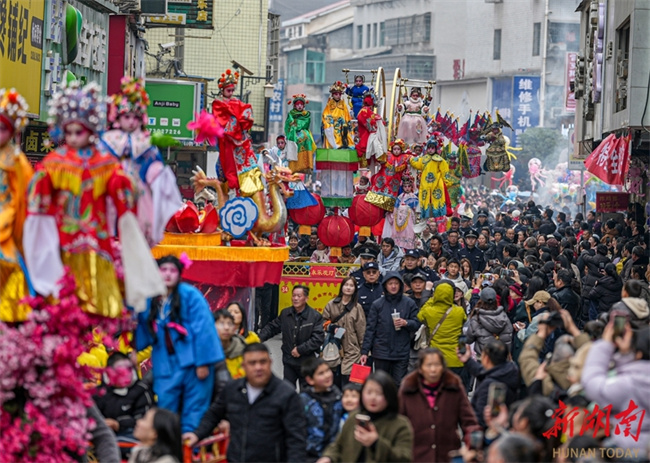
On March 2, a Changle Taige performance was staged in Changle Town, Miluo City, attracting crowds of tourists. The Changle Taige performance is a thousand-year-old folk tradition originating from the Sui and Tang dynasties (581-907) and thriving during the Ming and Qing dynasties (1368-1911). This art form evolved from ancient sacrificial rites and Lantern Festival celebrations held in the first month of the Chinese lunar calendar in ancient times, blending acrobatics, painting, opera, and folk customs. In 2011, the Changle Taige performance was included in the extended list of national intangible cultural heritage. (Photo/Song Zhengjun)
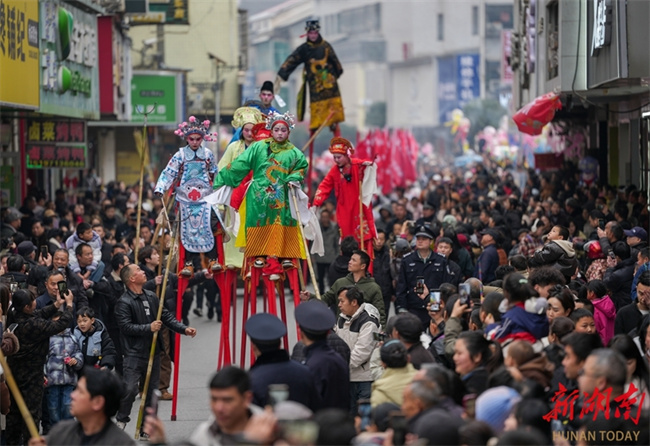
On March 2, a Changle Taige performance was staged in Changle Town, Miluo City, attracting crowds of tourists. The Changle Taige performance is a thousand-year-old folk tradition originating from the Sui and Tang dynasties (581-907) and thriving during the Ming and Qing dynasties (1368-1911). This art form evolved from ancient sacrificial rites and Lantern Festival celebrations held in the first month of the Chinese lunar calendar in ancient times, blending acrobatics, painting, opera, and folk customs. In 2011, the Changle Taige performance was included in the extended list of national intangible cultural heritage. (Photo/Song Zhengjun)
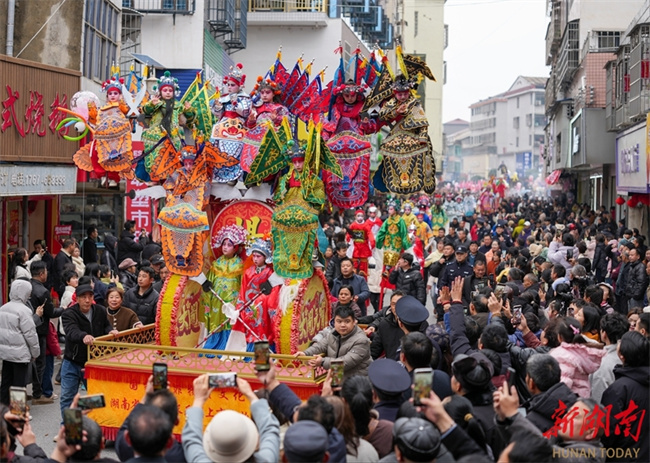
On March 2, a Changle Taige performance was staged in Changle Town, Miluo City, attracting crowds of tourists. The Changle Taige performance is a thousand-year-old folk tradition originating from the Sui and Tang dynasties (581-907) and thriving during the Ming and Qing dynasties (1368-1911). This art form evolved from ancient sacrificial rites and Lantern Festival celebrations held in the first month of the Chinese lunar calendar in ancient times, blending acrobatics, painting, opera, and folk customs. In 2011, the Changle Taige performance was included in the extended list of national intangible cultural heritage. (Photo/Song Zhengjun)
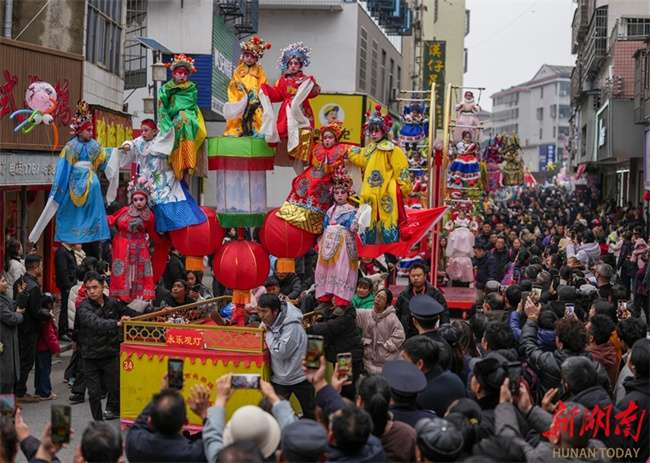
On March 2, a Changle Taige performance was staged in Changle Town, Miluo City, attracting crowds of tourists. The Changle Taige performance is a thousand-year-old folk tradition originating from the Sui and Tang dynasties (581-907) and thriving during the Ming and Qing dynasties (1368-1911). This art form evolved from ancient sacrificial rites and Lantern Festival celebrations held in the first month of the Chinese lunar calendar in ancient times, blending acrobatics, painting, opera, and folk customs. In 2011, the Changle Taige performance was included in the extended list of national intangible cultural heritage. (Photo/Song Zhengjun)
This article is from the Hunan Provincial Government www.enghunan.gov.cn.
Translator: Xiao Juan
Chinese source: hunantoday


