

Home>Tourism>Tour Hunan>Huaihua>Tourist Attractions
Jingping Ancient Village: Thousand-Year-Old Post Station Embraces "Slow Life" to Redefine Urban Leisure
Under the warm winter sun, friends and family gather around a rustic clay stove topped with a metal grate. They roast sweet potatoes and chestnuts while sipping warm herbal drinks or fruit teas, chatting about everyday life. In the ancient alleys and residential courtyards of Jingping Ancient Village in Zhongfang County, Huaihua City, visitors' leisurely moments are slowly warmed over the fire.
"As the weather turns colder, local shops are promoting 'stove-boiled
tea' packages, and visitors are enjoying the tranquility and coziness of
the ancient village," said Fang Yong, the operations manager. Pointing
to the post station in front of a courtyard which is restored to its
original charm, Fang Yong noted that just as this thousand-year-old post
station once served as a rest stop for weary travelers, the "slow life"
here is now attracting urban families.
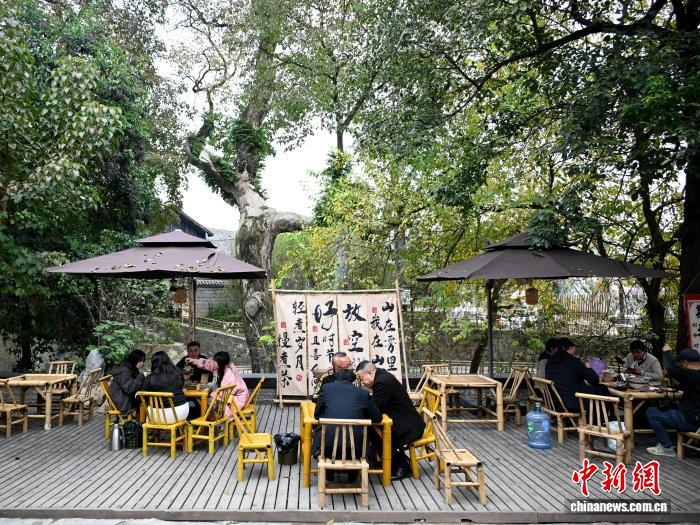
On December 11, visitors gathered around a stove to boil tea and enjoy
leisure time at Jingping Ancient Village in Zhongfang County, Huaihua
City. (Photo/Zhang Zhuo)
Jingping Ancient Village was once a major post station on the ancient
Beijing-Kunming Ancient Post Road. During the Northern Song Dynasty, the
Pan family migrated here, transforming the thorny wilderness into a
village. Today, multiple cultural relics remain here, including the Pan
Ancestral Hall, the Chastity and Filial Piety Archway, the Bagua (Eight
Trigrams) lanes from the Yuan and Ming dynasties, and architectural
complexes from the Ming and Qing dynasties. Over a thousand descendants
of the Pan family still live here.
"The ancient buildings are well preserved, the lanes are deep and quiet,
and the old trees are lush. It makes you temporarily forget the hustle
and bustle of the city, while preserving a unique 'lively daily life,'"
said Zhang Wenjie, a resident of Huaihua City who has led friends from
other places to visit the village many times. He noted that the village
retains its original charm while selectively incorporating a few trendy
businesses.
Jingping Ancient Village had long been an attraction without security,
facilities, and renovation. In May 2024, taking the opportunity of the
5th Hunan Tourism Development Conference being held in Huaihua, the
Beijing Tsinghua Tongheng Urban Planning & Design Institute carried
out comprehensive planning and design for the village's quality
improvement and renovation, tapping into its unique post road, ancient
music, and folk culture resources.
"We want to preserve the authenticity of the village to the greatest
extent, protect the living conditions of the original villagers, and use
idle spaces to develop cultural tourism facilities," said Ning Zhaowei,
the project leader. Apart from landscapes such as the ancient post road
and the ancient ferry, renovations for cultural venues, casual dining,
homestays, tea houses and coffee shops are only allowed in 15% of the
village's courtyards, so that new business formats of cultural tourism
coexist harmoniously with the authentic life of the original villagers.
Nestled among hills and waters, the ancient village combines "ancient
charm" and "trendy appeal." Historical relics such as the Wuchi Post
Road, the Bagua lanes from the Yuan and Ming dynasties, and
architectural complexes from the Ming and Qing dynasties are full of
vitality. Tea houses, a supply and marketing cooperative courtyard,
bars offering coffee by day and alcohol by night, antique-style
photography studios, and intangible cultural heritage workshops offer
something for everyone.
The traditional Chinese music and post road cultural experience hall,
empowered by "culture and technology," offers an immersive time-travel
experience. The masterpiece Dayue Yuanyin (The Prime Sounds of Great
Music) by Pan Shiquan, a renowned figure of the Pan family, and the
Zhongfang Post Station, which witnessed countless couriers galloping on
horseback, are brought to life through 3D projection, mirror spaces, and
light-and-shadow technology. Visitors can appreciate the new rhythm of
"ancient court music entering ordinary homes" and also enjoy the fun of
"time-traveling as an ancient courier."
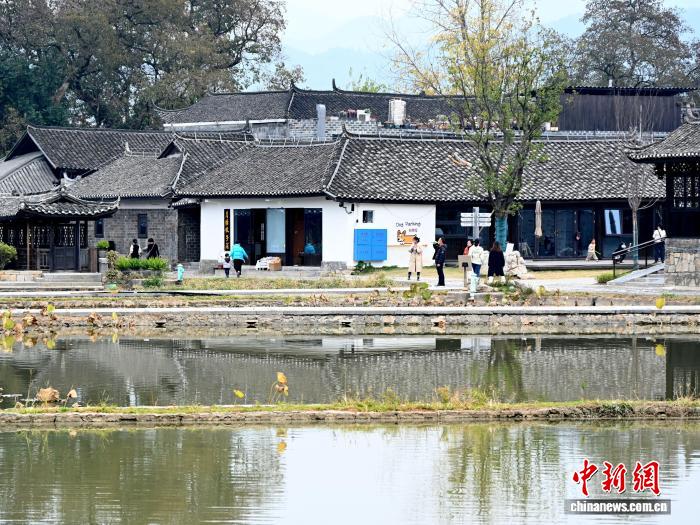
On December 11, visitors explored Jingping Ancient Village in Huaihua, where ancient charm met trendy appeal. (Photo/Fu Jingyi)
Today, villagers have also become part of the village's development.
Some work as guides, others run homestays or farmhouse restaurants, or
sell local specialties like rice tofu and sour radishes at stalls. Some
elderly craftsmen have joined the local market to teach intangible
cultural heritage skills. Business innovation is intertwined with the
rustic local life.
"Even during the off-season, we still receive about 50,000 tourist trips
per week," said Chen Yanlan, the village's operations manager from the
General Office of the Zhongfang County People's Government. The ancient
village shuns noise and embraces tranquility. With its profound
historical heritage and innovative experiences, the village offers
people a harbor to escape the fast pace of life and rediscover the
poetry of life.
Chinese source: Chinanews

 Hunan PSB Cyber Security Filing: No. 43010302000524