

Home>Tourism>Tour Hunan>Huaihua>Tourist Attractions
Mountain of Chinese Learning (Eryou Mountain)
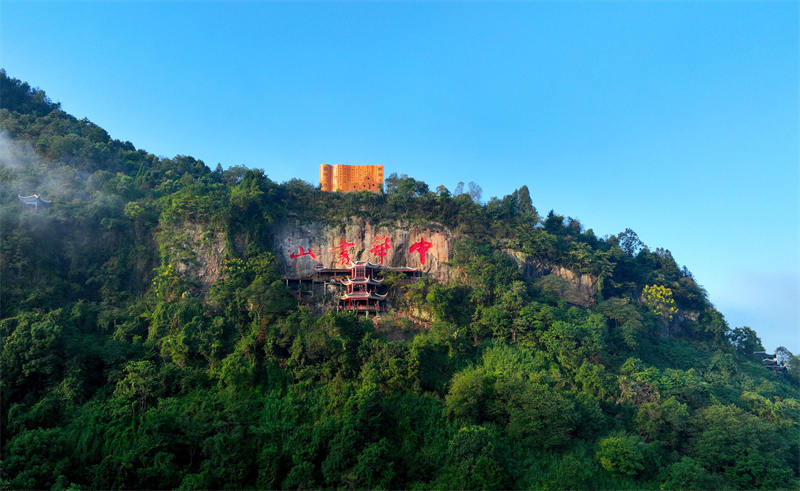
Eryou Mountain. (Photo provided by the Organizing Committee of the 5th Hunan Tourism Development Conference)
With towering cliffs, a jade-screen summit, a lotus-shaped base, and a celestial aura, Eryou Mountain is a place of exceptional beauty and spiritual energy, renowned as the finest among the famous mountains in Yuanling County. The mountain derives its name from the confluence of the Youshui River and Youxi Stream and is also known as "Ten-Thousand-Volume Rock" due to its undulating ridges that resemble the pages of a book. It is recognized as the 26th Blessed Land in Daoism.
According to legend, during the time when Emperor Qin Shihuang ordered the burning of books and the burying of scholars alive, court academician Fu Sheng risked the extermination of his entire clan to hide a thousand scrolls of bamboo manuscripts in the Eryou Book-hiding Cave. After the fall of the Qin Dynasty and the rise of the Han Dynasty, he retrieved and presented the manuscripts to the Han court, ensuring the survival and transmission of pre-Qin civilization. This made a monumental contribution to the continuity and development of China's 5,000-year civilization, giving rise to the idiom "learned as one with five cartloads of books, versed as one familiar with Eryou."
Eryou Mountain is revered as the Mountain of Chinese Learning. Emperor Shenzong of the Song Dynasty personally inscribed "Eryou Famous Mountain" at its peak to honor its contributions, while Zhang Hengjia, the Hunan Provincial Education Inspector, inscribed "Ancient Book Repository" beside the cave. For centuries, countless scholars, poets, and literati have made pilgrimages here, elevating Eryou Mountain into a symbol of Chinese civilization. The scenic area now features key attractions such as the Book-hiding Cave, the Ancient Book Repository Stele, Eryou Pavilion, Shutianmen (Book Heaven Gate), and Yangzhi Pavilion.
Chinese source: People's Daily

 Hunan PSB Cyber Security Filing: No. 43010302000524