

Home>Tourism>Tour Hunan>Changsha>Dining
Fire God Palace Restaurant
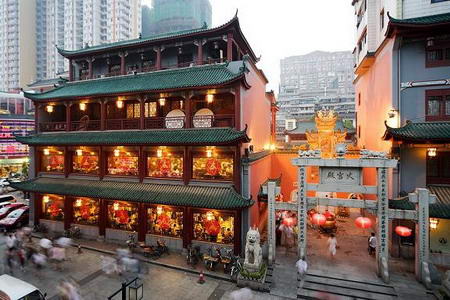
The Fire God Palace was originally a temple, first built in the 12th year of the Qianlong reign of the Qing Dynasty (1747). The temple was rebuilt in the 6th year of the Daoguang reign of the Qing Dynasty (1826) and also became known as "Qianyuan Palace." After the temple was built, a temple fair was held annually on the 23rd day of the sixth lunar month, with grand sacrificial ceremonies. This tradition has been passed down through generations, gradually turning the site into a bustling and distinctive snack venue, much like the City God Temple in Shanghai, the Confucius Temple in Nanjing, and Tianqiao in Beijing.
During the Republic of China era, the snack business at Fire God Palace grew increasingly prosperous. Originally, these food stalls had no permanent storefronts; vendors would set up temporary shelters and umbrellas, opening in the morning and closing at night. In the Wenxi Fire, all the buildings of Fire God Palace suffered a disastrous fate and were almost entirely destroyed. In 1941, the temple was rebuilt, and 48 wooden-framed shed rooms were constructed, leading to the gradual revival and emergence of a variety of distinctive local delicacies. Notable among them were: Jiang Erdie's stinky tofu, Zhou Fusheng's He Lan Fen (jelly-like strips made from fava bean starch), Hu Guiying's pig blood soup, Deng Chunxiu's braised pork trotters, Jiang sisters' glutinous rice balls, Zhang Guisheng's boiled fried dough twists, Li Ziquan's small clay bowl rice, Luo San's rice noodles, Chen Yixiang's marinated meats, and Hu Jianyue's ox-horn-shaped dumplings. Among them, Jiang Erdie's stinky tofu, Jiang sisters' glutinous rice balls, Zhang Guisheng's boiled fried dough twists, Li Ziquan's small clay bowl rice, and Hu Guiying's sesame oil pig blood soup are particularly renowned far and wide; they have survived to this day and remain as popular as ever.
After liberation, the once-disorganized "snack food cluster" was transformed into a modern restaurant, while retaining its specialty of serving primarily snacks. According to incomplete statistics, Fire God Palace Restaurant offers no fewer than 1,000 different items, with more than 40 types of snacks ranking first among peers in Changsha. Many customers come specifically to enjoy a meal of affordable, high-quality snacks.
In recent years, the restaurant has expanded its business scale, now operating three locations—the main store on Pozi Street, the Dongtang branch, and the Wuyi Road branch—with a combined operating area of 5,000 square meters. At the same time, the restaurant has invested heavily in a large-scale restoration and renovation of the original store, restoring the Fire God Temple, the God of Wealth Temple, the Amitabha Pavilion, the Puci (Universal Compassion) Pavilion, and the Opera Stage to their traditional styles. Today's Fire God Palace is a replica of what it was over 200 years ago, where four distinct cultures—cuisine, folk customs, traditional opera, and the Fire God Temple—are organically integrated. This century-old establishment not only excels in its street food offerings but also exudes a rich cultural atmosphere. Regardless of your social status—whether rich or poor—as long as you cherish the old traditions and folk customs of Changsha, you can find memories of the past here.
Chinese source: hunan.gov.cn

 Hunan PSB Cyber Security Filing: No. 43010302000524