


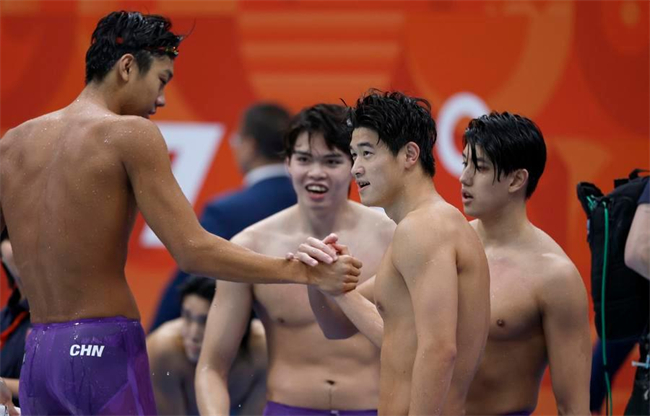
China completed a comeback in the final 50 meters to win the men's 4x200m freestyle relay gold in an Asian record of 7:00.17 at the 2026 Asian Games.
by sportswriters Zhang Can and Liu Yichun
TOKYO, Sept. 22 (Xinhua) -- With the final 50 meters approaching in the men's 4x200m freestyle relay final at the 2026 Asian Games on Monday night, China's Zhang Zhanshuo was still chasing the opponent from host Japan.
Then he surged past. China touched first in seven minutes 00.17 seconds, breaking the Asian record and completing a stunning comeback for the gold medal.
Composed of Xu Haibo, Fei Liwei, Pan Zhanle and Zhang Zhanshuo, China returned to the top of the Asian Games podium in the event for the first time in 16 years, while lowering the Asian record previously set by China.
It was a victory built from behind. Japan's Murasa Tatsuya made a strong start on the opening leg, leaving China's 18-year-old Xu Haibo to withstand the early pressure. Xu clocked 1:46.27 and handed over 1.57 seconds behind Japan.
"We expected to fight South Korea, but Japan put two of their strongest swimmers on the first two legs, which was a surprise," Pan, who shot to fame by winning two gold medals at the 2024 Olympic Games, said after the race. "After the first leg, we started 'eating the waves.'"
Swimming behind Japan, China's swimmers had to contend with the turbulence created by the leaders. Fei Liwei struggled to maintain his rhythm, and the deficit grew to 3.47 seconds after the second leg.
Then came Pan. On the third leg, the men's 100m world record holder launched a relentless pursuit. By the first turn, he had already draw back more than half a second. He eventually completed his leg in 1:44.24, cutting the deficit to 1.89 seconds.
China was still behind. But the race had changed.
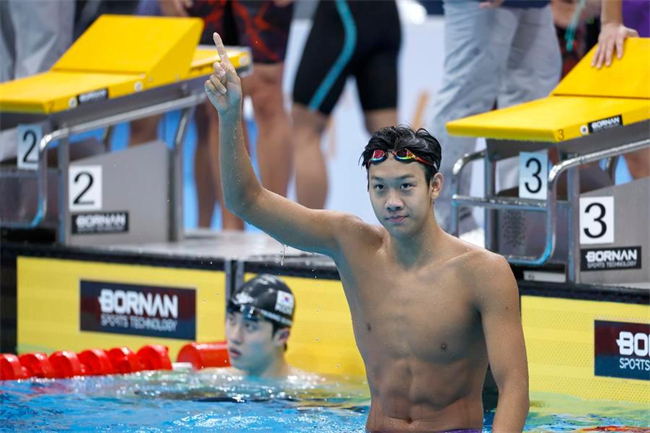
Zhang celebrates after the race. (Xinhua/Wu Zhizun)
Zhang dived in for the final leg, with the water churning around him and Japan still in front. After 100 meters, Zhang had reduced the gap to roughly half a body length. At the final turn, he continued to close in, inch by inch, until the two swimmers were almost level.
"Seeing him swimming through the waves and pushing so hard, I was thinking, 'He's so tired,'" Pan recalled.
In the final stretch, Zhang pulled level and then surged ahead.
The cheers erupted around the Tokyo Aquatics Centre. In the press tribune, Chinese reporters who had been watching the race from their seats rose almost simultaneously, shouting and cheering. The tension that had built over the previous seven minutes exploded into celebration.
Even amid the excitement around the pool, the cry of "Zhang Zhanshuo! Zhang Zhanshuo!" rang out.
Zhang stopped the clock at 1:42.92, finishing his leg 2.77 seconds faster than his Japanese counterpart and completing the comeback.
For Xu, watching the final leg was almost unbearable. "Seeing Zhang Zhanshuo gradually catch up, my heart was almost jumping out of my chest," he said. "I was so excited that I shouted my throat out."
After the race, the 18-year-old could barely contain his excitement. "Having these three amazing teammates is just great," Xu said, calling Zhang "Shuoshen" - which translates as "God Zhang" - in an affectionate nickname.
Zhang, however, was not quick to accept the praise. "I had confidence that I could make the comeback. I have three very strong teammates," he said, looking toward Pan, "including a world-record holder. Why should I be afraid of the opponents?"
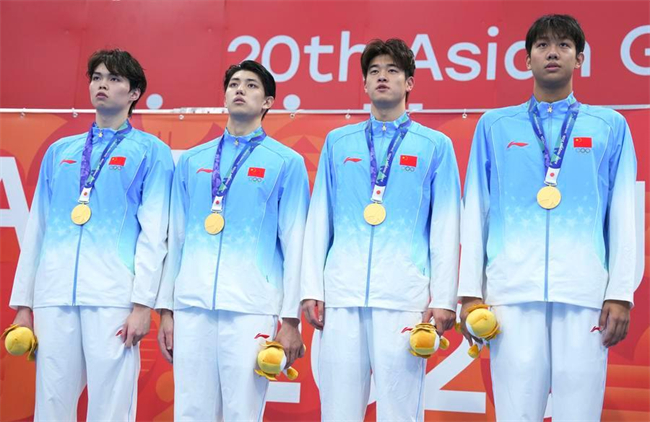
Xu, Fei, Pan and Zhang (L to R) pose on the award ceremony. (Xinhua/Chen Zeguo)
Pan, for his part, said the relay had helped him rediscover some of the form he showed at the national championships, while acknowledging that he still had room to improve.
For Fei, the Asian record belonged not to one swimmer, but to the whole team. "The result could not have been achieved without the support of the whole team and the national team," Fei said. "It is a great honor to race this relay with these three excellent teammates. Breaking the Asian record is an honor for every one of us."
Zhang's 1:42.92 split was one of the most eye-catching performances of the night, but the young anchor was quick to look beyond his own time.
"The world record is right there," he said. "Someone has made 1:42.0 in an individual race, while I did 1:42.9 in a relay. I still need to calm down, face the gap and keep learning from the world record."
The 20-year-old is competing in seven events at these Games, making energy management a major challenge.
But after a comeback that demanded everything he had, Zhang did not talk about fatigue, and he offered a simple assessment of the night.
"This is a very good start," he said. "My Asian Games have just begun."
Source: Xinhua




 Hunan PSB Cyber Security Filing: No. 43010302000524