


"In 2012, on the return trip from an inspection in India, my mentor (Yuan Longping) mentioned that the low seed yield of hybrid rice there constrained promotion overseas. He repeatedly urged us to have a sense of urgency and responsibility to overcome the challenge of ultra-high-yield seed production," recalled team leader Deng Huafeng.
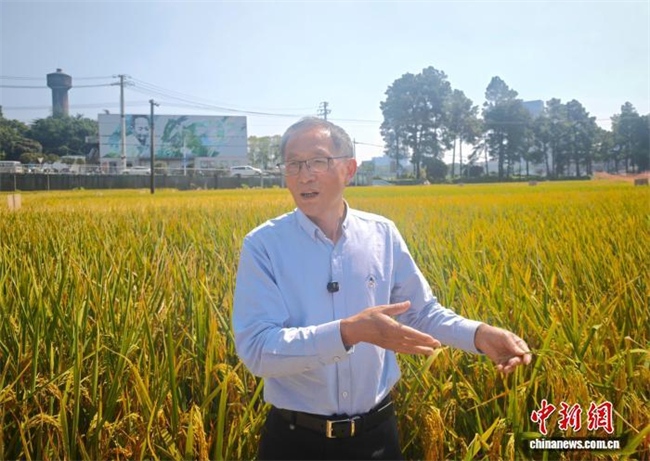
Recently, Deng Huafeng, leader of the Yuan Longping Hybrid Rice Innovation Team at the Hunan Hybrid Rice Research Center, introduces the situation of hybrid rice seed production in the field in Changsha. (Photo/Tang Xiaoqing)
After the passing of Academician Yuan Longping, the team has continued to tackle ultra-high-yield seed production technology. After years of improvement, this technology can achieve stable high yields in different regions and under diverse climatic conditions, with yield records repeatedly broken. "As hybrid rice goes global, the biggest technical bottleneck is that seed production technology is difficult to replicate overseas. Only by further increasing seed production yields can the dream that hybrid rice will be grown around the globe be better realized," said Deng Huafeng.
Shu Fu, a researcher at the Hunan Hybrid Rice Research Center, introduced that to promote the application of hybrid rice in partner countries, China's Ministry of Science and Technology approved the establishment of the China-Madagascar Belt and Road Joint Laboratory on Hybrid Rice in 2024. At present, the hybrid rice varieties screened and bred in Madagascar by the laboratory, in cooperation with Yuan's High-tech Seed Industry Co., Ltd., can yield an average of 7.5 tonnes per hectare, about 2.7 times that of local conventional varieties (averaging 2.8 tonnes per hectare).
"Seed supply is a prominent bottleneck in overseas promotion of hybrid rice," said Shu Fu. The laboratory proposed the idea of localizing seed production and is actively promoting local production of hybrid rice seeds in Madagascar.
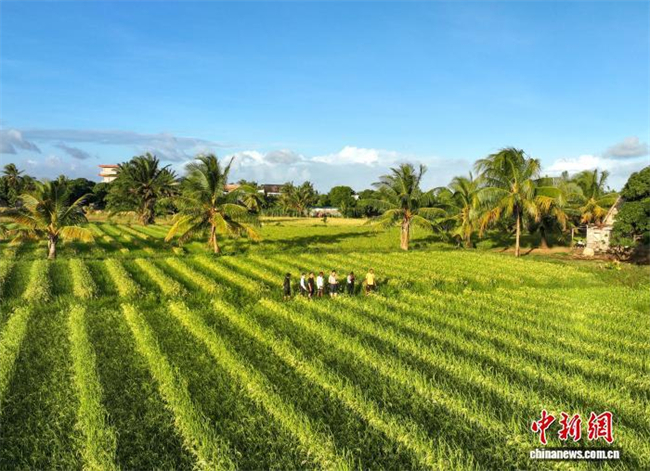
In July 2025, hybrid rice experts from the Hunan Academy of Agricultural Sciences inspect hybrid rice seed production at a hybrid rice seed production base on the outskirts of Sambava, Madagascar. (Photo provided by the Hunan Hybrid Rice Research Center)
Through sustained efforts to tackle key technical challenges and demonstration cultivation, more than 70 countries worldwide are conducting hybrid rice research or cultivation, with the overseas cultivated area of hybrid rice reaching nearly eight million hectares. Tang Wenbang, director of the Hunan Hybrid Rice Research Center, said that China's overseas promotion of hybrid rice uses Madagascar as a pivot to extend to other African countries and other Belt and Road partner countries, adopting a parallel model of technology export and two-way talent cultivation.
"The research team cultivates reserve talent at different levels and collaborates with multiple universities on joint postgraduate training." Tang Wenbang revealed that Hunan Agricultural University launched a "Longping Class" this year, aiming to build a pool of professional researchers in hybrid rice.
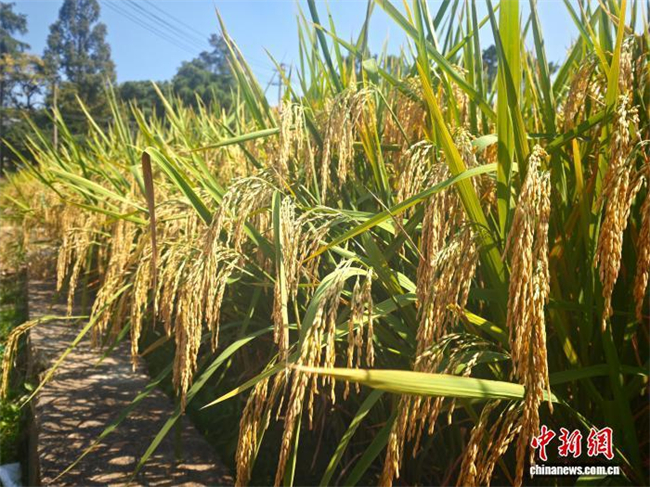
Recently, new high-yield and high-quality hybrid rice varieties planted in the field in Changsha feature a high seed-setting rate. (Photo/Tang Xiaoqing)
"Hybrid rice promotion has achieved the most notable results in Vietnam, the Philippines, and Pakistan," said Liu Aimin, a researcher at the Hunan Hybrid Rice Research Center. A dual path of "seed export + local seed production" has been adopted in hybrid rice promotion overseas—domestic seed enterprises export seeds, while research institutions set up overseas R&D centers in multiple countries to breed varieties adapted to local conditions.
"Talent cultivation is also an important part of international cooperation." Liu Aimin said that the Hunan Hybrid Rice Research Center, in cooperation with Yuan Longping High-tech Agriculture Co., Ltd., has established a training institute, giving systematic training in China to technical personnel from Africa and Southeast Asia. Meanwhile, Chinese experts also go overseas for on-site teaching, improving the capabilities of local technical personnel through hands-on guidance.
This article is from Hunan Provincial Government. www.enghunan.gov.cn.
Translator: Pang Yuehui
Chinese source: hunan.gov.cn
"Hybrid rice promotion has achieved the most notable results in Vietnam, the Philippines, and Pakistan," said Liu Aimin, a researcher at the Hunan Hybrid Rice Research Center. A dual path of "seed export + local seed production" has been adopted in hybrid rice promotion overseas—domestic seed enterprises export seeds, while research institutions set up overseas R&D centers in multiple countries to breed varieties adapted to local conditions.
"Talent cultivation is also an important part of international cooperation." Liu Aimin said that the Hunan Hybrid Rice Research Center, in cooperation with Yuan Longping High-tech Agriculture Co., Ltd., has established a training institute, giving systematic training in China to technical personnel from Africa and Southeast Asia. Meanwhile, Chinese experts also go overseas for on-site teaching, improving the capabilities of local technical personnel through hands-on guidance.
This article is from Hunan Provincial Government. www.enghunan.gov.cn.
Translator: Pang Yuehui
Chinese source: hunan.gov.cn




 Hunan PSB Cyber Security Filing: No. 43010302000524