


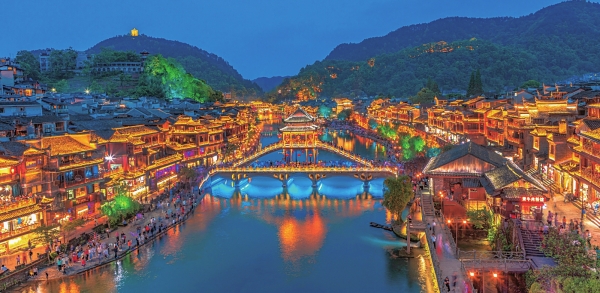
Fenghuang Ancient Town on a summer night is brilliantly lit and bustling with tourists. (Photo/Zhang Hanyan)
Recently, an activity themed "Go Xiangxi: Global Reporters and Content Creators Unveil Hidden Gems" was held in Fenghuang Ancient Town in Xiangxi Tujia and Miao Autonomous Prefecture. Thai TNN reporter Pichayapa Sutabutra changed into Miao ethnic attire, boarded a boat, and enthusiastically learned to sing Miao songs. Over several days, the international friends visited the Aizhai Bridge, Dehang Miao Village, Shibadong Village, and Laosicheng Site, shared their impressions and expressions of awe on social media throughout the journey.
Why are visitors from afar willing to stay a few extra days? The answer lies in every concrete step taken by the Xiangxi Tujia and Miao Autonomous Prefecture to develop its culture and tourism—not by replicating scenic views, but by showcasing daily life to visitors and leaving it for them to stay and experience, so that the world can "read" Xiangxi.
Turning "Day-trippers" into "Overnight Guests"
The landscape of Fenghuang, Xiangxi, nurtures its people, giving rise to renowned figures such as Shen Congwen, Huang Yongyu, and Xiong Xiling; in turn, the people give back to these landscapes by writing about and painting Xiangxi, thereby spreading its fame far and wide.
The Former Residence of Shen Congwen completed its exhibition upgrade this year. An actor dressed as the young Shen Congwen performs the dance, as visitors join in reciting the opening lines of "Border Town"—"From Sichuan to Hunan, there is an official road on the eastern side…" Those who can recite it are awarded a "Xiangxi Literary Knight" medal.
As night falls, the "Meet in Xiangxi · Tuojiang" cruise boat glides downstream. Huang Yongyu's long calligraphy and painting scroll "Both Banks of the Tuojiang in Fenghuang" is projected on the riverbank stone wall, with Shen Congwen's love poems appearing on the water screen, and a girl in red on a bamboo raft catches a red umbrella floating from the sky—that is Cuicui, the protagonist of "Border Town."
Sichuan tourist Bai Yongxian enjoyed shefan (a traditional Miao rice dish) and sour soup fish, and he said, "Fenghuang's nights are livelier than its days." This performance, drawn from Fenghuang's cultural heritage, is half about local charm, half about business.
With more and more foreign faces around, taxi driver Zhang Degui picked up two groups of foreigners in one day—one group from the UK and one from Malaysia. Travel photographer Awen, who in previous years would get only one booking from foreign clients every half month, got two or three bookings a week this summer.
At noon, German tourist Hans took a seat at the Phoenix International Hotel, ordered a milder version of duck with blood-sticky rice cake, and paid by card. The hotel's "guest preference file," covering 20 countries, is filled with dense notes: Thai guests "are allowed to cook for themselves," and "Western-style ingredients" are stocked for European and American guests—all to make visitors from afar feel "at home."
Fenghuang Ancient Town is focusing on turning "visitors" into "overnight guests" through night tours, driving growth in homestay bookings and bringing new vitality to local restaurants. In the first half of this year, Fenghuang received over 110,000 inbound tourist visits, with inbound tourist spending totaling 44.28 million USD, a year-on-year increase of 15.18%.
What Xiangxi seeks is more than just the bustle of a single town—Fenghuang. Centered on world heritage site, ethnic culture, red history, ecological wellness, and outdoor sports, the prefecture has launched five themed routes. Furong Town, leveraging the reputation of Laosicheng Site, has developed itself into a "must-see stop," and the three-day tour route "Tianmen Mountain—Furong Town—Laosicheng Site" has attracted over 120,000 visits diverted from Zhangjiajie in just half a year. The Aizhai-Shibadong route integrates spectacular canyon views, a model of poverty alleviation, and Miao folk customs, with the number of educational tour groups up 40% year-on-year in the first half of the year. The "Enter from Zhangjiajie, Exit from Fenghuang" loop route connects 12 core scenic areas in Xiangxi. Through cooperation with Zhangjiajie's travel agencies, 300,000 inbound tourists are expected to visit Xiangxi, turning transit visitors into overnight guests.
Turning "Cultural Assets" into an "Industrial Ledger"
Xiangxi has no shortage of culture; what it lacks are ways to monetize that culture. The prefecture is home to 30 national-level, 111 provincial-level, and 1,272 prefecture- and county-level intangible cultural heritage items, each a living craft passed down through the ages. Now they are being showcased on shelves and performed on stages.
On September 20, the Jiugui Liquor Huang Yongyu Packaging Art Experience Hall opened. In early 1987, Huang Yongyu named this liquor "Jiugui" in Fenghuang and designed its ceramic bottle—"Gui suggests a free-spirited, unconventional character." That ceramic bottle is a classic example of turning Xiangxi culture into value. Now this connection has taken physical form, becoming a hall where visitors can see and experience it firsthand.
Culture must be seen before it can come alive. Xiangxi Autonomous Prefecture's digital intangible cultural heritage platform has collected more than 4,000 items, which users can listen to, view, and learn from with just a click. Buses in Jishou have been adorned with Miao embroidery patterns, becoming "intangible cultural heritage buses" on the streets. The group standards for "Xiangxi Youli" public brand were released and rolled out both online and offline, with sales of intangible cultural heritage creative products up 21% year on year. At the intangible cultural heritage workshop in Shilan Town, Huayuan County, more than 400 female embroiderers "embroider at work and care for children and the elderly after work," earning an average monthly income of 4,000 CNY. Miao embroidery cooperatives have created jobs for more than 3,000 people.
Going out is meant to attract more visitors in. The dance drama "Dance of 24 Solar Terms" has transitioned from touring to a resident performance, signing a contract to settle at Fenghuang Gate-Jinshui Village, where visitors can enjoy the scenery by day and watch the show by night. The acrobatic drama "A Journey of Dream — Mysterious Xiangxi" has brought Xiangxi stories to audiences overseas, with 916 performances worldwide, including 121 in Spain alone. With the show continuing to reach international audiences, visitors keep flowing in; many people first watch the show "Mysterious Xiangxi" and then come to explore the region's scenic beauty.
In the first half of this year, Xiangxi Autonomous Prefecture's tourist arrivals and total tourist spending increased by 4.37% and 3.93% respectively on a comparable statistical basis. Among these, inbound tourist visits totaled 170,300, with total inbound tourist spending reaching 71.0161 million USD, a year-on-year increase of 3.79%. The prefecture's 14 key cultural tourism projects completed investment of 703 million CNY, achieving an investment completion rate of 79.34%.
Cultural assets are being transformed into scenes, products, and performances, turning traditional crafts into tangible income.
From "Enjoying Mountains and Waters" to "Understanding History and the People"
Xiangxi's landscapes are not only worth admiring but also deserve to be appreciated slowly.
To truly appreciate the landscape, one must first understand its significance. As one of the world's most densely concentrated areas of karst gorges, Xiangxi Global Geopark covers 2,710 square kilometers across seven counties and cities. With a drop of 236 meters, Jianduoduo Waterfall is one of the highest single-drop waterfalls in China. The 17-kilometer canyon river course of Mengdong River in Yongshun welcomed over 7,000 visits in a single day during the summer. In front of the Dehang Liusha Waterfall, twin sisters from Mallorca, Spain, spread out mats and practiced yoga.
The development plan for the Shibadong outdoor sports destination has been implemented, bringing a mountain trail running challenge to the Miao village. The "Cycling on the Clouds" Bicycle Invitational Race on Bamian Mountain is held every year, and the "Xingyunju" tent camp and Baojing's "202 Village" hot spring homestays welcome guests. The landscape isn't just for viewing—it's also for recreation and accommodation.
Reading history means tracing the origins of the past through 1,517 historic sites. The 38,000 Liye Qin bamboo slips have filled a gap in the history of the Qin Dynasty. At the Liye Ancient Town (Qin Slips) Museum, the 3D virtual character "Qin Xiaojian" answers visitors' questions with ease. At the 800-year-old Laosicheng Site, students on a study tour crouch down to measure the carvings on Ming-era city wall bricks with their hands.
Understanding the people means learning about the locals who have secured their livelihoods through tourism. Leveraging Guzhang Maojian Tea and Baojing Golden Tea, Xiangxi has adopted the approach of "revitalizing tea through culture and promoting tourism through tea," driving income growth for more than 200,000 people. The four major scenic areas—Fenghuang Ancient Town, Aizhai-Shibadong-Dehang Grand Canyon, Furong Town, and Laosicheng Site—have spurred tourism development in 113 villages, and more than 500,000 people across the prefecture now earn a living from tourism. The landscape nurtures the people, and the people, in turn, nurture the landscape.
Welcoming visitors from afar requires solid expertise. A barrier-free payment mechanism has been established, with all scenic areas at 4A-level and above in the prefecture accepting international credit cards, and more than 800 merchants having completed upgrades. Communication is well-supported, with trilingual (Chinese, English, and Korean) signage and guided tours covering key scenic areas, and the prefecture's first 30-person foreign-language tour guide team has been established. Transportation is very convenient, with the Biancheng Airport operating six flight routes and a 1.5-hour "high-speed rail plus direct shuttle" connection between Fenghuang and Zhangjiajie.
Bringing visitors in and keeping them there also depends on a new group of faces —cultural tourism curators. This September, Xiangxi released the "Initiative for Co-building of Cultural Tourism Curators Ecosystem in Greater Zhangjiajie International Tourism Area." Old villages and old wooden houses are transformed by these curators into new scenes that visitors flock to.
The gates to the mountains are wide open — the world comes to "read" Xiangxi!
This article is from Hunan Provincial Government. www.enghunan.gov.cn.
Translator: Xiao Juan
Chinese source: Hunan Daily




 Hunan PSB Cyber Security Filing: No. 43010302000524