


The Ecology and Environment Department of Hunan Province released the 2025 Report on the State of the Ecology and Environment in Hunan Province on June 4. Data shows that in 2025, the proportion of days with good air quality in urban areas reached 91.3%, with the concentration of PM2.5 down 4.7% year on year. The proportion of surface water sections classified as good quality was 97.9%, while all of the centralized drinking water sources met the required standards, indicating that the ecological conditions remained generally stable.
On the same day, the Hunan main venue event for World Environment Day 2026 was held at the Daze Lake Near-Natural Wetland Park in Wangcheng District, Changsha City. The event systematically reviewed Hunan's achievements in ecological civilization construction since the launch of the "14th Five-Year Plan," and clearly outlined the blueprint for ecological and environmental protection during the "15th Five-Year Plan" period.
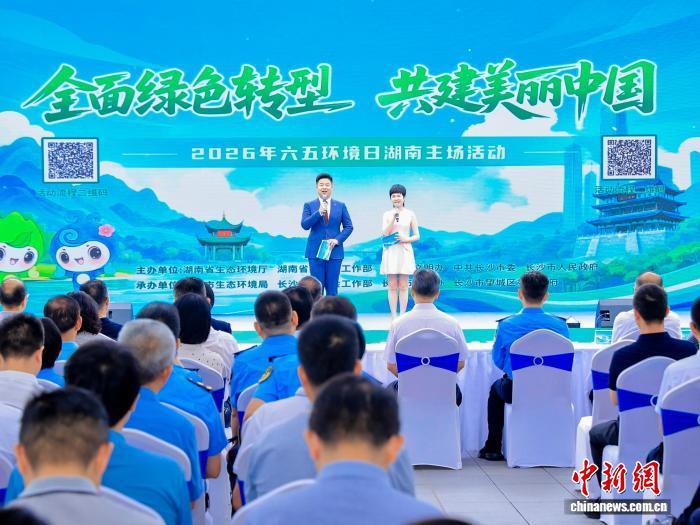
The Hunan main venue event for World Environment Day 2026 is held in Changsha on June 4. The 2025 Report on the State of the Ecology and Environment in Hunan Province is released on site. (Photo/Zhang Xueying)
In recent years, Hunan has focused on green development goals, striving to keep skies blue, waters clear, and lands pollution-free. The province has continuously deepened reforms in the ecological civilization system, introducing the "Several Provisions of Hunan Province on the Prevention and Control of Noise Pollution" and the "Several Provisions of Hunan Province on the Comprehensive Utilization of Straw"; amending the "Regulations of Hunan Province on Environmental Protection"; advancing the implementation of the "Regulations of Hunan Province on the Prevention and Control of Water Pollution"; and, releasing four local ecological and environmental standards. It has coordinated the reform of the ecological and environmental damage compensation system, rolling out a slew of legal, market, technological, and policy measures to enhance the effectiveness of ecological and environmental governance.
Regarding atmospheric governance, Hunan has targeted pollution from mobile and industrial sources with precise measures. A cumulative total of 43,799 diesel trucks meeting emission standards of China III and below and 42,648 units of outdated construction machinery and agricultural equipment have been phased out. Significant efforts have been made to control industrial pollution, completing ultra-low emission transformations for the entire processes of three steel enterprises. The province has completed ultra-low emission renovation projects for several cement and coking enterprises, as well as steam boilers with a single output of 65t/h or more, and has advanced upgrading transformations for key enterprises in sectors such as bricks and tiles, ceramics, secondary zinc oxide, non-ferrous metals, glass, and volatile organic compounds (VOCs). The province has added 175 enterprises with environmental performance ratings of A or B, as well as leading enterprises.
Hunan Province is characterized by numerous rivers and dense water networks, with 5,341 rivers measuring over 5 kilometers in length. The four major river systems—the Xiangjiang, Zijiang, Yuanjiang, and Lishui rivers—converge at Dongting Lake before flowing into the Yangtze River. In 2025, Hunan's water quality continued to improve, with the proportion of 147 surface water sections monitored by the state with excellent or good quality standing at 98.6% for four consecutive years, and no surface water at inferior Grade V was recorded. The water quality of main streams of the "the Yangtze River and the Xiangjiang, Zijiang, Yuanjiang, and Lishui rivers" maintained at or above Grade II for six consecutive years, and the total phosphorus concentration in Dongting Lake decreased by 7.0% compared to 2024. The aquatic ecosystem has also been steadily recovering, with 174 fish species monitored across the "the Yangtze River, the Dongting Lake, and the Xiangjiang, Zijiang, Yuanjiang, and Lishui rivers," 474,100 migratory birds overwintering in Dongting Lake, and the populations of finless porpoises and Milu deer reaching 194 and nearly 400 individuals, respectively.
Hunan has also continuously advanced the battle for keeping land pollution-free, focusing on soil pollution risk management and rural environmental governance to ensure that soil environmental quality remains stable and continues to improve. In 2025, 10.0618 million mu (about 670,786 hectares)of contaminated farmland across the province will be safely utilized, with the safe utilization rate of contaminated farmland stabilizing at over 93%. Risk control and remediation measures have been implemented for 544 plots of land designated for "residential, public management and public service," ensuring the continued safe utilization of key construction land. The pollution control rate for priority supervision land reached 99.8%.
This event was jointly organized by the Ecology and Environment Department, the Social Work Department, and the Civilization Office of Hunan Province, as well as the CPC Changsha Municipal Committee and the Changsha Municipal People's Government.
This article is from Hunan Provincial Government. www.enghunan.gov.cn.
Translator: Xiao Juan
Chinese source: Chinanews




 Hunan PSB Cyber Security Filing: No. 43010302000524