

History and Culture
Home > About Hunan > National Customs
Hand-Waving Dance: "Oriental Disco" of the Tujia People in Western Hunan
At the Rebala Scenic Area in Longshan County in Hunan, the sound of gongs and drums echoes through the valley. Tourists and performers form a circle in front of the Baishou Hall, bending their knees slightly, lowering their bodies, and swaying their arms in unison with the drumbeat. Dozens and sometimes hundreds of people move to the rhythm, dancing the Tujia Baishou or Hand-Waving Dance.
The Tujia hand-waving dance has been passed down through generations in Longshan, Baojing, and Yongshun in the Wuling mountainous area of Hunan. Its signature movement is swinging the arm and leg on the same side in sync. It may look awkward to outsiders, but the Tujia people perform the dance with effortless grace.
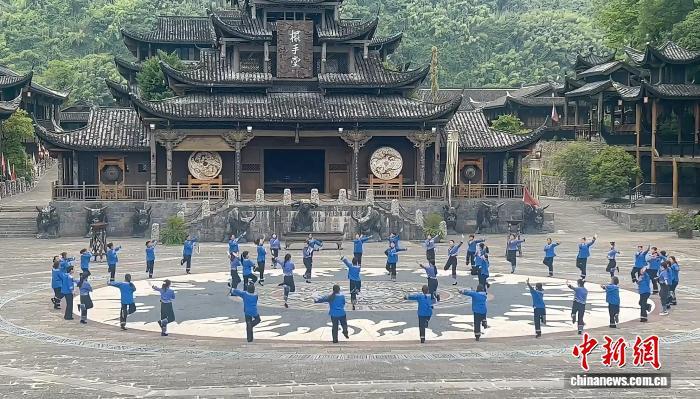
On August 17, performers rehearse the Tujia hand-waving dance at the Rebala Scenic Area in Longshan County, Hunan Province. (Photo/Peng Jirong)
"This is closely related to the living environment of the Wuling mountainous area," said Chen Tingliang, a professor at Jishou University who has long been engaged in ethnology. He explained that in the past, the Tujia people mostly lived in mountain valleys and hollows, where narrow, winding paths led right outside their doors. Walking sideways and clambering up slopes were part of daily life, leading to physical habits characterized by a low center of gravity and same-side limb coordination. "The seemingly awkward same-side dance steps are in fact a continuation of the survival wisdom of mountain dwellers," Prof. Chen noted.
Prof. Chen explained that the hand-waving dance is divided into the "Great Hand-Waving" and the "Small Hand-Waving." In the Tujia language, the "Great Hand-Waving" is called Yetihei, meaning "the dance to honor the gods"; the "Small Hand-Waving" is called Shebari meaning "the dance for the ancestral gods." It is widely believed that the hand-waving dance originated from ancient ancestor worship rituals, with records found in documents such as the eighteenth-century Qianlong-era "Local Gazetteer of Yongshun Prefecture" and the nineteenth-century Jiaqing-era "Local Gazetteer of Longshan County," dating the tradition back nearly a thousand years.
With its vigorous movements and strong rhythm, the hand-waving dance is open to everyone—men and women, young and old, tall and short, slim and stout—and has been hailed as the "oriental disco." Chen Xuan, a teacher at the College of Music and Dance of Jishou University, explained, "The mass participation and collective revelry of disco resonate with the spirit of the hand-waving dance."
"Tujia people can perform the Baishou Dance as soon as they can walk." A reporter recently visited Longshan County, where Liu Chunhong, head of the Rebala Scenic Area, said that during holidays, the hand-waving dance is always the highlight of the scenic area. The performers are mostly local villagers, and tourists are also invited to join in. "They form a circle while dancing—the more people there are, the livelier it gets."
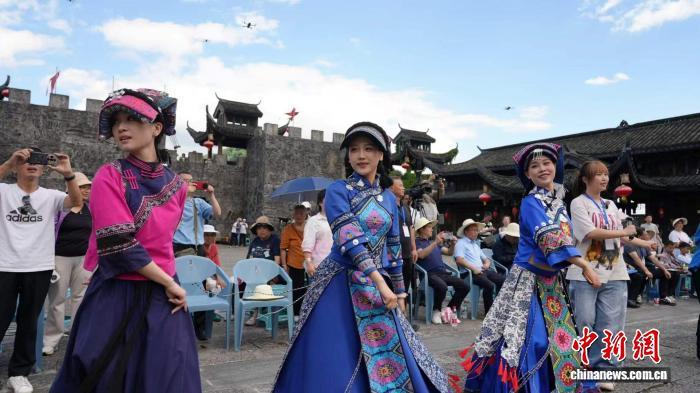
On June 13, Tujia girls in splendid attire perform the hand-waving dance in the Xiangxi Tujia and Miao Autonomous Prefecture, Hunan Province. (Photo/Mo Daiyin)
The movements of the Tujia hand-waving dance are extremely rich and varied, including ritual dances, hunting dances, farming dances, migration dances, and folk custom dances. Farming activities such as harrowing fields, transplanting rice seedlings, and spinning can all be integrated into the dance. Chen Xuan said that generations of Tujia people have "woven" their daily labor into the movements, and memories of their production and daily life unfold one after another in the dance steps.
Now that the modes of production have changed, the hand-waving dance has also been adjusted accordingly. "Creators extract elements from the postures and rhythms of the hand-waving dance and combine them with modern choreography to create works that align with contemporary aesthetics," said Chen Xuan. The myriad forms of life can all serve as new inspiration for the hand-waving dance.
Zhang Mingguang, a representative inheritor of the national intangible cultural heritage, explained that the hand-waving dance performed in villages around the Spring Festival follows fixed rituals—including "inviting the gods," sacrificial offerings, and sweeping the hall—all officiated by the village's highly respected ritual master.
As the 25th-generation ritual master of the hand-waving dance, Zhang Mingguang, now nearly ninety years old, still passes on his art. At the Shebari grand ceremony in Longshan County, he holds a staff as tall as his eyebrows, dancing and singing as he officiates the event. His lyrics include ancient songs about his ancestors' migrations and seasonal reminders for farming activities.
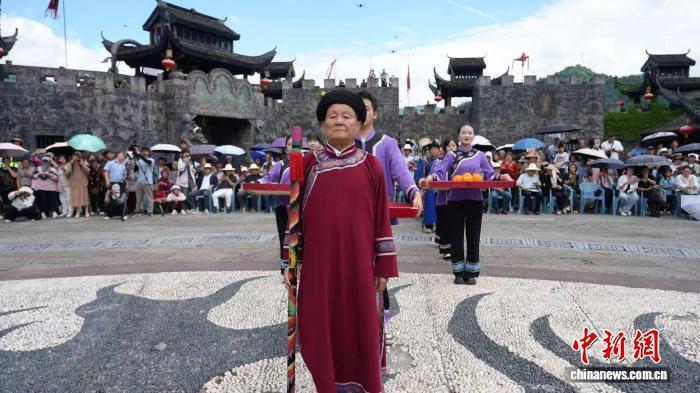
On June 13, Zhang Mingguang, with a staff in hand, officiates the hand-waving dance ceremony during the Shebari celebrations in Longshan County. Zhang is a representative inheritor of the Tujia hand-waving dance, a national intangible cultural heritage item. (Photo/Mo Daiyin)
According to Chen Tingliang, the Baishou Hall is both a cultural classroom and a social mediator. "'Inviting the gods' is an act of gratitude, sacrificial rites honor the ancestors, and sweeping the hall is a way to restore social order. Conflicts in the village are often resolved during the hand-waving dance. After drinking and dancing together, people can have a heart-to-heart talk," added Chen.
The integration of culture and tourism has brought the hand-waving dance from villages to tourists. Liu Chunhong said that villagers eagerly sign up whenever a performance is organized. "In 2025, the scenic area received more than 400,000 visits. With a growing number of tourists, the villagers now earn income from performances, and local homestays, restaurants, and specialty products are also booming."
In the dance circle in front of the Baishou Hall, the sound of gongs and drums intertwines with the laughter of tourists and villagers, echoing through the river valleys of the Wuling mountainous area. Forming a circle with waving hands and moving to the rhythm, the thousand-year-old dance will continue to live on.
Chinese source: Chinanews